

spot_img
Sunday, March 1, 2026
More
    spot_img
    Home Blog Page 23

    Pharmacists address questions over new prescribing powers in Ontario

    0

    Since new legislation came into effect on Jan. 1 allowing Ontario pharmacists to prescribe for 13 “minor ailments,” some doctors have taken to social media to voice concerns.

    With the ability to assess and write prescriptions for conditions such as pink eye and uncomplicated urinary tract infections — a regulatory change that brings Ontario in step with nine other provinces and territories — some doctors and students questioned the move in opinion columns and social media posts, suggesting pharmacists could potentially miss a more serious diagnosis, or that their new powers could lead to an over-prescribing of antibiotics.

    Jen Belcher, vice-president of strategic initiatives and member relations at the Ontario Pharmacists Association, said most of the discussion has been happening on social media, but the association has also had “productive” one-on-one conversations with physicians to answer their questions.

    “Although there are a few voices that are raising these flags, generally most physicians welcome this,” said Mina Tadrous, an assistant professor of pharmacy at the University of Toronto who specializes in drug policy and has been monitoring the reaction.

    Story continues below advertisement

    “I think some of these concerns are coming from a place … (of) thinking about what’s best for their patients and what’s best for the health-care system,” said Tadrous, who was on the advisory committee that helped decide which minor ailments pharmacists should start prescribing for in Ontario.

    Those ailments also include acid reflux, cold sores, oral thrush, allergies and hayfever, some types of rashes, painful menstruation, hemorrhoids, impetigo, insect bites and musculoskeletal sprains and strains. They can also prescribe preventative antibiotics for Lyme disease.

    Concerns from the public or the medical community could be eased with a better understanding of what the changes actually mean – and the fact that pharmacists have already been prescribing medications in other parts of Canada for years, Tadrous said.  

    “We’ve been able to watch what’s occurred in other provinces and learn from it,” said Tadrous,

    In Alberta, pharmacists can prescribe most medications, with the exception of narcotics.

    Pharmacists in Saskatchewan, Manitoba, Quebec, New Brunswick, Prince Edward Island, Nova Scotia,  Newfoundland and Labrador and Yukon can prescribe medication for several “common or minor ailments,” according to information gathered by the Canadian Foundation for Pharmacy and the Canadian Pharmacists Association.

    Story continues below advertisement

    British Columbia is set to allow pharmacist-prescribing for minor ailments and some forms of contraception this spring.

    Beverley Zwicker, CEO and registrar for the Nova Scotia College of Pharmacists, said pharmacists outside Ontario are “sort of scratching our heads a little bit … (about) a lot of hoopla over something that everyone has been doing for a long time, clearly without harm.”

    The Canadian Press asked Belcher, Tadrous, Zwicker and other experts to respond to the three most common questions they’ve been getting.

    Question:  Could pharmacists miss potential serious diagnoses?  For example, what if a heartburn complaint is really a heart condition, or an uncomplicated urinary tract infection is really a sexually transmitted infection?

    Response: Pharmacists are clinically trained to recognize “red flags” when a patient comes in looking for a treatment for what appears to be a minor condition, Tadrous said.

    Canadian pharmacy students get “just over 90 hours of instruction on these minor ailments,” said Belcher in an email.

    “We have been assessing for these ailments as part of general practice, just without the ability to prescribe.”

    Zwicker agreed, noting, for example, that customers were already coming in to seek advice on over-the-counter products that could help alleviate the symptoms of heartburn.

    Story continues below advertisement

    The only change with the ability to prescribe, she said, is that pharmacists can offer more suggestions for available treatments. During that interaction, pharmacists can talk to patients about what to do if their condition doesn’t get better and redirect them to their doctor, nurse practitioner or the emergency department if there are indications it could be something more serious.

    “Although what the public sees is mostly pharmacists dispensing medication, their scope is actually much broader,” Zwicker said.

    Click to play video: 'Ontario pharmacies set to prescribe medicine for common ailments in 2023'


    Ontario pharmacies set to prescribe medicine for common ailments in 2023


    Question:  Is there a financial conflict of interest for pharmacists to be prescribing drugs?

    Response: “We are professionals and ethically bound to do what is best for our patients, no different than any other health-care professional,” said Margaret Wing, chief executive officer of the Alberta Pharmacists’ Association.

    Pharmacists in that province have had the broadest prescribing scope in Canada for more than a decade, and there’s no reason to believe inappropriate prescribing has occurred, she said.

    Story continues below advertisement

    “Pharmacists in Alberta are initiating 433,500 new prescriptions annually, or less than 1% of the total 55 million prescriptions dispensed annually in Alberta. I believe that is evidence that pharmacists are not over-prescribing,” Wing said in an email.

    Ontario legislation stipulates a patient receiving a prescription from a pharmacist can fill it anywhere they choose, Tadrous said, meaning there’s not necessarily a financial incentive for the prescribing pharmacist.

    There are potential conflicts of interest in any profession, Tadrous said, adding pharmacists are licensed and must follow professional ethics.

    Plus, “in many cases, pharmacists aren’t paid by the prescription,” Tadrous said. “These are (mostly) people who work as employees somewhere, and if they give out more prescriptions … there’s no incentive there for them.”

    Question:  Could giving prescribing powers to pharmacists lead to over-prescription of antibiotics and contribute to antimicrobial resistance (AMR)?

    Response:  There has been no “uptick” in antibiotic prescriptions in provinces where pharmacists have prescribing authority, Tadrous said.

    “Most of the evidence points in the other direction – that pharmacists are better (antibiotic) stewards than physicians are,” he said.

    Andrew McArthur, a professor at the David Braley Centre for Antibiotic Discovery and M.G. DeGroote Institute for Infectious Disease Research at McMaster University, agreed.

    Story continues below advertisement

    “Overall, pharmacists are highly trusted members of our health systems and already play a strong role in combatting AMR by ensuring patients do not misuse their antibiotics,” McArthur wrote in an email.

    “One of the major drivers of AMR is patients stopping use early because they feel better and pharmacists have been key in reducing this behaviour.”

    How COVID continues to impact training of surgeons in Canada: ‘Not business as usual’

    0

    Training of surgeons in Canada has taken a heavy knock from the chaos of the COVID-19 pandemic, and some doctors say their clinical education has been delayed again in recent months as many hospitals across the country cancelled elective procedures to keep up with emergency care.

    Far from looking forward to entering the workforce, some newly graduated surgeons say they are worried and frustrated about backlogs that have put operations on hold.

    “I went months without participating in regular surgeries,” said Dr. Kelly Brennan, a general surgery trainee in eastern Ontario.

    Delays also affected less urgent specialty procedures such as endoscopies, Brennan added.

    Story continues below advertisement

    Provinces are taking different measures to address surgical backlogs. The Ontario government recently said in a release it’s investing over $300 million over the next year and launching a new software tool aimed at managing the wait list. This month Premier Doug Ford also announced a plan to expand the number and types of procedures to be offered at private clinics.

    According to a report commissioned by the Canadian Medical Association released last September, British Columbia plans a $303-million investment over the next three years to speed up diagnostic imaging and surgical procedures.

    Manitoba’s 2022 budget included a $110-million investment to reduce backlogs while Saskatchewan plans to ascribe $21.6 million to addressing the surgical wait-list as it anticipates a return to pre-COVID wait times by the end of March 2025. Nova Scotia similarly endorsed a plan to return to national benchmarks for surgical wait times by 2025.


    Click to play video: 'The Training Ground: What it takes to be a cardiac surgeon'


    The Training Ground: What it takes to be a cardiac surgeon


    Despite this infusion of government money, it’s unclear whether there will be enough medical professionals, including nurses, to accomplish these goals, Brennan said about Ontario’s plans.

    Story continues below advertisement

    “Nurse staffing continues to be a challenge,” she said, noting also that hospital patient volumes are high, there’s a shortage of beds, and elective cases are often disproportionately affected by delays.

    “While things are improving, it is not business as usual,” said Dr. Najma Ahmed, a trauma surgeon and educator in Toronto.

    “University hospitals are doctor factories. When they are not running it causes teaching delays that are to the detriment of learners,” she added.

    “Nothing replaces going to the operating room,” Ahmed said.

    A University of Toronto study published in July 2021 found that about four out of five doctors in plastic surgery residency training programs across Canada believed the pandemic curtailed their exposure to operations and clinical skills, damaging their future educational and practice plans.

    Dr. Sultan Al-Shaqsi, a plastic surgeon and one of the study’s authors, said that during much of 2020 there were fewer residents than usual in operating rooms, and even fewer medical students.

    In the case of surgical specialties like orthopaedics or plastic surgery, many have missed on-the-job training, especially involving “intricate elective surgical procedures, which have been delayed by COVID,” says Al-Shaqsi.

    Moving to a largely online format of lectures, surgical videos and simulations made it harder to teach the technicalities of procedures and give feedback, Al-Shaqsi said.

    Story continues below advertisement


    Click to play video: 'Code Blue: Does Canada need a parallel private health-care system?'


    Code Blue: Does Canada need a parallel private health-care system?


    When the pandemic struck in March 2020, medical schools expanded virtual care and reassigned learners to COVID-19 and vaccine-related work. The Canadian Institute for Health Information estimates the number of surgeries plummeted by 600,000 in the first 18 months of the pandemic compared to expected numbers for that period.

    And while service is improving at some hospitals, a triple threat of COVID-19, flu and respiratory syncytial virus (RSV) illnesses this past fall hit many institutions hard as they dealt with an influx of patients, many of them children. Pediatric hospitals across the country cancelled or limited elective procedures.

    Al-Shaqsi said he worries that some surgical residents have delayed further subspecialty training, including cancer surgery, or minimally invasive procedures, until surgical care stabilizes.

    As fellowship training often focuses on highly specialized and infrequent surgeries, Al-Shaqsi said learners are concerned they will not receive enough training if surgeries don’t return to normal volumes soon.

    Story continues below advertisement

    This means that while most surgical residents are graduating and entering the workforce on schedule, they are potentially doing so without the further specialty skills they would garner in a fellowship program _ at a time when patients can least afford to wait.

    The National Resident Matching Program (NRMP), which governs entry into many surgical subspecialty programs in the United States and Canada, listed only 43 Canadian applicants in 2022, down from 70 in 2018. That’s despite an increase in available positions over that same period.

    In Al-Shaqsi’s own specialty of craniofacial surgery, which regularly filled all specialty spots before COVID-19, more than half a dozen fellowship spots now go unfilled.

    “Elective procedures such as knee ligament repairs and other sports injuries were also delayed,” said Dr. Youjin Chang, an orthopedic surgeon who completed her final fellowship training in 2022 and is based in Ontario’s Durham region.

    “Even as we are emerging from the worst of the pandemic, staffing pressures in hospitals are still preventing a return to normalcy,” Chang said, adding daily operating room schedules are “often hours behind,” and “smaller elective cases are the most likely to be affected.”

    The delays took a physical and emotional toll on patients stuck in the backlog.

    “Our trainees, and patients, suffered greatly,” Ahmed said.

    Story continues below advertisement

    “Initially, we were operating only on very sick patients. It made teaching and mentoring very difficult,” she said of the early days of the pandemic.

    “Now, the backlog is so large we need health and human resource solutions.”

    A recent Fraser Institute report said “Canada’s health-care wait times reached 27.4 weeks in 2022 _ the longest ever recorded _ and were 195 per cent higher than the 9.3 weeks Canadians waited in 1993.

    The Professional Association of Residents of Ontario, which advocates for early-career doctors, flagged concern about changes made to surgical education early in the pandemic.


    Click to play video: 'Health care specialists in Saskatchewan use robots in new research program'


    Health care specialists in Saskatchewan use robots in new research program


    According to a mid-2020 survey of its members, over 40 per cent of respondents reported they had been assigned to direct patient care instead of attending surgeries and clinics. Nearly 45 per cent of residents noted increased work hours and on-call requirements to cover sick colleagues.

    Story continues below advertisement

    In response to the findings in their survey, PARO is pushing for universities to base student evaluations on a holistic view of a resident’s performance during training, as well as their skill set, rather than a minimum number of clinical hours spent in a certain rotation.

    This is part of a broader evolution in medical education towards competency-based, instead of time-based, evaluation of skills.

    The Royal College of Physicians and Surgeons of Canada has also signalled it wants a more flexible approach to medical education.

    “Perfection is not the goal,” the college says in a publication, updated in early 2022, with guidance on changes to training during the pandemic. They reinforce that “patient care takes precedence” and individual accommodations may be needed as “graduating residents and trainees must be competent to practise unsupervised.”

    Advances in augmented reality and simulation-based training for surgeons may also enable new surgical residents to gain more operating experience than their predecessors.

    While Al-Shaqsi is optimistic about the role of simulation and augmented reality in the future of surgical education, he noted these technologies are not yet advanced enough to provide comparable education to actual surgeries.

    Story continues below advertisement

    Ahmed said that it will take more than high-tech solutions to deal with the current backlog.

    More post-acute care, rehabilitation, elder care, long-term care and resources across the spectrum are needed in order to improve surgical care throughout the country, she said.

    “With COVID, at first, it was all hands on deck,” Ahmed said.

    But “now there is a lack of trained humans” due to the staffing crisis facing Canada’s hospitals, she said.

    This report by The Canadian Press was first Jan. 27, 2023

    Dr. Adam Pyle is an emergency medicine physician and lecturer at the University of Toronto, and a journalism fellow at the Dalla Lana School of Public Health.

    New alcohol guidance: When are provinces planning to adopt measures?

    0

    Politicians in charge of provincial and territorial liquor laws aren’t hurrying to adopt or promote newly updated guidelines that advise a steep drop in Canadian drinking habits.

    Across Canada, the responsible ministers declined interview requests from The Canadian Press. In written responses, they didn’t commit to changing marketing methods for alcohol and noted they’re awaiting Ottawa’s lead on whether to slap warning labels on products.

    In some cases, such as Nunavut and British Columbia, governments say they’re actively reviewing the guidelines. Two provinces – New Brunswick and Nova Scotia – said their Health departments are developing plans to incorporate the new advice.

    The guidance prepared by the Canadian Centre on Substance Use and Addiction for Health Canada and released on Jan. 17 represents a major shift from its 2011 advice that having two drinks a day was considered low risk. The updated report says there is a moderate risk of harm for those who consume between three and six standard drinks a week, and it increases for every additional drink.

    Story continues below advertisement

    Kevin Shield, a professor at University of Toronto’s school of public health, notes about two-thirds of Canadians who drink are consuming in the guideline’s riskier ranges, according to the most recent Statistics Canada survey.

    Shield – who studies methods used by governments to reduce harms caused by alcohol _ said in an interview Wednesday that liquor agencies aren’t currently giving consumers a good sense of the long-term health risks of alcohol. The typical messages, he said, are: “Don’t drink and drive, don’t drink while pregnant and please enjoy responsibly,” with only the Northwest Territories including labels warning of health impacts.


    Click to play video: 'Do we need warning labels on alcohol bottles as Canada outlines new consumption guidelines?'


    Do we need warning labels on alcohol bottles as Canada outlines new consumption guidelines?


    Some governments have been loosening marketing restrictions. For example, in its 2019 budget, Ontario’s Progressive Conservatives called for earlier serving hours for bars and restaurants, alcohol in municipal parks and advertising of free alcohol by casinos.

    The province’s Finance Department said in an emailed response it’s “aware” of the CCSA update but didn’t comment on whether the province’s liquor corporation, the LCBO, will alter its policies. The LCBO website contains a link to the updated guidelines, but finding it requires surfing through three other topics before reaching a link written in small type at the bottom of a page.

    Story continues below advertisement

    Tim Stockwell, the former head of the Canadian Institute for Substance Use Research at the University of Victoria, said the reality is the issue isn’t a political priority.

    “They’re thinking about the economy, and tourism and the vitality of nightlife in their cities. The last thing on policymakers’ minds is whether this commodity we’re so familiar with is doing any harm,” he said in an interview Tuesday.

    The liquor corporations continue to be key sources of revenue to their provinces, with the B.C. agency providing close to $1.2 billion in the last fiscal year, Ontario’s LCBO providing about $2.4 billion and Quebec’s SAQ reporting a $1.35-billion profit.

    A spokesman for Quebec’s finance minister said the province isn’t considering any changes to the provincial liquor corporation’s current practices. “We trust citizens to make the best decisions for their health, in light of the latest knowledge on the subject,” spokeswoman Claudia Loupret said.

    In Nova Scotia, Finance Minister Allan MacMaster said liquor education materials “do not yet” reflect the new guidance. Beverley Ware, a spokeswoman for the province’s liquor corporation, said the Department of Health “plans to develop materials to inform Nova Scotians of the new guidance on alcohol and health,” and the liquor retailer is in favour of sharing this information with its customers.

    Story continues below advertisement


    Click to play video: 'Exploring alcohol-free living'


    Exploring alcohol-free living


    A spokesman for New Brunswick’s Health Department said it supports the updated guidelines and is working on a communication plan to help New Brunswickers understand them.

    Siobhan Coady, the finance minister in Newfoundland and Labrador, provided an email saying her officials are “always mindful of new research,” noting the province was already examining whether to introduce policies that limit liquor consumption _ including raising the minimum price for drinks sold in bars.

    Manitoba’s government didn’t comment on how it will incorporate the guidelines into its liquor marketing, but noted its liquor corporation has a “DrinkSense” website that encourages responsible consumption.

    Meanwhile, none of the provinces reached by The Canadian Press indicated they are considering directly implementing the call for health warning labels, though the Northwest Territories does already have a label mentioning the risk to pregnant women and drivers, and noting alcohol “may cause health problems.”

    Story continues below advertisement

    Nunavut’s Finance Department said in an email it is reviewing its alcohol regulations, including possible warning label requirements, and will “note the findings” of the CCSA in its review.

    David Morris, a spokesman for the Saskatchewan liquor authority, said the province’s retail liquor system will be fully private later this year and there are no plans to change the way private retailers in the province sell or market alcoholic beverages.


    Click to play video: 'Changing the culture around alcohol'


    Changing the culture around alcohol


    A spokesperson for British Columbia’s Ministry of Mental Health and Addictions said the province will be reviewing the CCSA guidelines and “have more to say in the weeks ahead.”

    Manitoba, Saskatchewan, Nova Scotia and Yukon said it’s up to Ottawa to take the lead on creating warning labels that discuss the risks of cancer, heart disease and stroke. Carolyn Bennett, the federal minister of mental health and addictions, was unavailable for an interview, and her office said she’s reviewing the CCSA’s advice.

    Story continues below advertisement

    Dan Malleck, a professor of health sciences at Brock University who has been critical of the CCSA guidelines, said the provinces are right to be reluctant about adopting the updated guidelines. “I think any reasonable government should ignore the guidelines completely,” he said in an email. “It’s poor research, ideologically driven, and based upon spurious connections with health harms.”

    — With files from Allison Jones, Steve Lambert, Terri Theodore, Kelly Malone, Colette Derworiz, Hina Alam, Sidhartha Banerjee and Emily Blake.

    As sexual assault rates rise, provinces face shortages of specially trained nurses

    0

    As rates of sexual assault climb across Canada, nursing experts say there is a shortage of specially trained forensic nurses to properly care for victims.

    Timely care from a well-trained forensic nurse can help stave off a cascade of post-traumatic effects, including depression, anxiety and even suicide, said Sheila Early, president of the Canadian Forensic Nurses Association.

    “I always thought that as an emergency nurse, what I did was I put Band-Aids on these individuals. But as a forensic nurse, I helped them make that first step to whatever recovery that will come,” Early said in a recent interview.

    Sexual assault nurse examiners are forensic nurses trained to collect evidence from sexual assault and domestic violence victims, and to help them cope with trauma. They can also be called to testify in court. Their expertise requires hours of dedicated training — at least 60 hours in Nova Scotia, plus observation training in a gynecological practice, said Martha Paynter, an assistant nursing professor at the University of New Brunswick.

    Story continues below advertisement

    “Their evidence gathering is a very different type of nursing work,” Paynter said in an interview. It’s also “extremely traumatizing work,” she said, “and it takes somebody who really wants to do it.”

    Despite the emotional toll and the extensive training they carry, sexual assault nurse examiner positions are often casual roles, requiring the nurse to juggle on-call hours on top of their full-time nursing jobs, said both Paynter and Early. In the midst of a health-care crisis and widespread nursing shortages, it’s no wonder some provinces are struggling to find nurses who will take on the extra load, they said.

    New Brunswick’s Vitalite Health Network cancelled training planned for February because too few nurses signed up, officials confirmed in a recent email. In the health region covering Labrador and parts of northern Newfoundland, officials confirmed they too put off training the region’s first sexual assault nurse examiners after too few nurses responded to a call for interest last year.


    Click to play video: 'N.B. sexual assault nurse program under scrutiny amid staff shortage'


    N.B. sexual assault nurse program under scrutiny amid staff shortage


    The Labrador-Grenfell health authority said it will issue another call for interest this week.

    Story continues below advertisement

    There are also forensic nurse shortages in Ontario and Saskatchewan, according to nurses unions in those provinces.

    “Dedicated funding is required to ensure every sexual assault (and) domestic violence centre in Ontario can provide 24-7 access to (sexual assault nurse examiners) for survivors,” said a statement from the Ontario Nurses’ Association, adding that it was “deeply concerned” about the shortage.

    Meanwhile, Statistics Canada reports that the rate of police-reported sexual assaults in Canada rose by 18 per cent in 2021 compared to the year before, with the highest increases in Quebec, Newfoundland and Labrador and New Brunswick. In 2020, the rate of sexual assault in Labrador was six times the national average.

    Paynter said nurses need to be given more flexibility to take on other duties and training.

    “A lot of nurses would love to do this work,” she said. “So how do we make the whole sector more flexible so that people can fit in these other things? We know that nurses are happier, they’re most fulfilled when their scope is broadest.”

    Early said sexual assault nurse examiner expertise should be recognized as a specialty designation by the Canadian Nurses Association. That way, she said, there would be more funding for training and positions. The association did not immediately respond to a request for comment.

    Provinces also need to stop relying on casual forensic nurses, and offer them stable, full-time work in the role, Early said.

    Story continues below advertisement

    “Violence is a public health-care issue. So why don’t we deal with it on that level?”

    This report by The Canadian Press was first published Feb. 2, 2023.

    &copy 2023 The Canadian Press

    Sask. request for COVID-19 help a surprise to feds

    0

    Public Safety Canada and the Canadian Armed Forces were caught off guard by a request for help from Saskatchewan during the height of the fourth wave of the COVID-19 pandemic.

    Documents obtained under freedom of information laws show employees in the federal departments were surprised when Saskatchewan Health Minister Paul Merriman sent a letter in October 2021 to then-federal health minister Patty Hajdu requesting help.

    “Unforeseen (request for assistance) for (Saskatchewan) came into Ottawa through (Minister) Hajdu,” said an email from Maj.-Gen. Paul Prevost, who runs the military centre called the Strategic Joint Staff on Oct. 18.

    “(Government of Canada), as us, are surprised by this,” said another email from Lt.-Col Dave Morency.

    Story continues below advertisement

    It was unexpected because Merriman had turned down an offer of federal support and, emails show, there was no indication a formal request would be on the horizon.

    The Saskatchewan government has not responded to a request for comment.

    The 50 pages of emails that are partially redacted show that near the end of September 2021 and early October, the two federal departments were tracking an increasing number of infections, hospitalizations and pressures on intensive care units in Saskatchewan.

    Saskatchewan was reporting record-high numbers of people in hospital and front-line health-care workers were voicing their concern that it would get worse. Surgeries and tests were being cancelled and staff were redeployed to COVID-19 wards.

    Prevost said in an email on Sept. 29 that the situation is “getting worse; worse than Alberta in some parts of the (province).”

    Related Videos

    Story continues below advertisement

    “We continue to discuss with (Saskatchewan) but there are no mentions of (request for assistance),” Prevost wrote.

    Alberta was also facing significant pressures at the time with soaring hospitalizations and infections after it lifted COVID-19 public health orders over the summer. Then-premier Jason Kenney faced significant backlash when he walked back his “best summer ever” comments, tightening restrictions and asking the federal government for assistance.

    The Saskatchewan government was watching what Alberta was doing, emails show.

    Maj. Dave Fedoruk wrote on Oct. 5 that Saskatchewan was possibly interested in a federal response such as Alberta’s, but the province did not have its own information available during a recent meeting to “speak meaningfully” to what was needed.

    The email added that Saskatchewan participants in the meeting “stated they do not have authority to submit a (request for assistance) at this time.”

    However, at the time the Saskatchewan government was reaching out to several places in the United States for assistance.

    Saskatchewan Public Safety Agency president Marlo Pritchard would later say the province reached out to members of the Northern Emergency Management Assistance Compact, through the International Emergency Management Assistance Memorandum of Understanding, and to the Pacific Northwest Emergency Management Agreement, which connects the province with possible help from member states, including Illinois, Montana, Indiana, Michigan, New York, Minnesota, Ohio, North Dakota, Pennsylvania and Wisconsin.

    Story continues below advertisement

    No state helped.

    Hajdu said she had urged the province to take federal support in the weeks before they finally reached out. She said in an interview with The Canadian Press at the end of September 2021 that if the province needed nurses, respiratory therapists or doctors, the federal government needed to know sooner rather than later.

    “I really stressed to Minister Merriman the best plan is the one we make ahead of time, and we need to work together to make sure we can adequately understand what Saskatchewan needs might be,” Hajdu said.

    A few weeks later, a request for urgent assistance would come to Hajdu’s office.

    “Saskatchewan is reaching a critical point in our response to the fourth wave of the COVID-19 pandemic, and we are in need of external support to manage patient care in a safe and sustainable manner. We have an immediate need for assistance from the federal government,” said Merriman’s letter to Hajdu on Oct. 18, 2021.

    Public Safety Canada and the Canadian Armed Forces quickly began emailing each other about how to best respond to the unexpected request.

    “Perhaps we should discuss this fairly urgently,” said an email from James Gulak with Public Safety Canada. “Caught everyone by surprise and originated in the political realm.”

    Story continues below advertisement

    Generally, a formal request for assistance is submitted to Public Safety Canada, the lead co-ordinator of the federal response to these operations, outlining how much help is needed and in what areas.

    Even Saskatchewan front-line workers emailed they were not expecting the request.

    “My apologies, I was only made aware of it in the last five minutes,” Kim Olsen, director of intergovernmental relations with Saskatchewan Public Safety Agency, said in an email about the request.

    Jessica Lamirande, with the federal Department of National Defence, said in an email that the Canadian Armed Forces monitor trends to evaluate possible requests for support.

    The Canadian Armed Forces responded to the 2021 request with aircraft assistance and personnel to fly patients from Saskatchewan to Ontario. They also provided critical care nurses to help at Regina General Hospital and other nursing supports.

    “Given the unpredictable nature of the pandemic, we were prepared for situations to quickly change, and ensured that the Canadian Armed Forces remained ready to help provinces and territories that required assistance,” Lamirande said.

    &copy 2023 The Canadian Press

    Saskatchewan underestimated need for rapid tests: emails

    0

    SASKATOON — Saskatchewan underestimated how many rapid antigen tests were needed during the height of the fourth wave of the COVID-19 pandemic, while also touting the tests as a key part of its plan to halt transmission of the virus, internal emails indicate.

    Documents obtained under freedom of information laws show the province emailing Health Canada in September and October 2021 asking for millions more tests than were originally requested.

    “Our warehouse has just confirmed that they have shipped over half of the 500,000 tests that were received last week, and orders for test kits are coming in faster than anticipated from all corners of the province,” said an email from the province on Sept. 20.

    Story continues below advertisement

    The 120 pages of emails that are partially redacted show correspondence between Health Canada staff and Saskatchewan government and health authority employees regarding COVID-19 assistance in late 2021 as the province faced surging infections, hospitalizations and pressures on intensive care units. All names of provincial employees have been redacted.

    Saskatchewan’s Ministry of Health says the province anticipated strong public demand for rapid antigen test kits, and took measures as early as May 2021 for them to be used by individuals for self-testing.

    “As a sufficient supply of tests was secured from the federal government, the province opened wider public distribution channels, eventually resulting in over 600 locations where the public could access tests,” the ministry said in a statement.

    The province said as of last Friday, Saskatchewan has distributed over 25 million rapid tests, including 11.8 million tests directly to the public.

    At the start of September, provincial health authority staff initially emailed Health Canada saying one million tests would be sufficient for at least two months — and suggested to Ottawa the province could receive them in biweekly batches of 250,000.

    Related Videos

    Story continues below advertisement

    Saskatchewan had just announced an at-home testing pilot for students under the age of 12, along with their families. Emails show there was also increasing demand for workplace screening across the province.

    A little more than a week later, the authority emailed Health Canada to say its warehouse was empty and requested a scheduled delivery of tests be expedited.

    “With your warehouse out of supplies, does that change your demand of 500,000 tests in September and 500,000 in October?” Sebastien Poirier with Health Canada asked in an email on Sept. 11.

    The province reassured the federal department its original order was enough.

    “The total of (one) million tests arriving in September and October is forecast to meet our needs,” said an email from the province on Sept. 12.

    The next day the province issued a new provincial emergency order. A week later, emails showed, it became clear that number of rapid tests would not be enough.

    The province requested an additional one million tests for October — on top of the 500,000 it had already ordered. The federal department responded in an email that it was “juggling a few urgent requests” and had limited inventory.

    Story continues below advertisement

    Saskatchewan was reporting record-high numbers of people in hospital from the wave fuelled by the Delta COVID-19 variant and front-line health-care workers were voicing their concern that it would get worse. Surgeries and tests were being cancelled and staff were redeployed to COVID-19 wards.

    Parents were posting on social media how there weren’t enough tests for the at-home testing pilot for students. The Saskatchewan Teachers’ Federation issued a public call for the government to improve measures to help keep children from getting COVID-19.

    By the end of September, Saskatchewan asked for two million tests for the next month. That bumped up even more in October.

    “If 3.5 (million) is available, we would take them. Just wanted to make sure that this request is in addition to what we have requested for the October allocation,” an email from the province said.

    At that time, Saskatchewan was also urging universities and businesses with more than 200 employees to contact the federal government for a program that distributed COVID-19 screening kits.

    Emails show that Health Canada employees usually redirected educational institutions back to provinces to get the COVID-19 tests and it was worried about what Saskatchewan’s demands would do to the overall supply.

    Story continues below advertisement

    “In my view, with the public health situation in (Saskatchewan), we should assist,” wrote Angie Barrados, with Health Canada, in a Sept. 28 email.

    Saskatchewan Health Minister Paul Merriman had declined federal support at the end of September as COVID-19 pressures mounted on the province. The federal government was caught off guard when Merriman requested urgent help only a few weeks later.

    Demand for the rapid test kits came from across Canada and some leaders criticized the federal government for a lack of supply. Without an abundance of tests, provinces and territories were rolling out different plans for distribution, most erring on the side of caution that there may not be much access to tests.

    Emails showed Health Canada was sharing information with Saskatchewan about upcoming test procurements and the possibilities to support that province.

    By mid-October, Saskatchewan was preparing to hand out 1.3 million rapid self-test kits to the public at fire halls, local chambers of commerce and health authority testing centres.

    “Starting the week of Oct. 18, Saskatchewan households will be able to take home a COVID-19 rapid antigen test kit to support asymptomatic testing,” Premier Scott Moe posted on social media.

    Access was expanded further in November and they were available to libraries and Co-op grocery stores.

    Story continues below advertisement

    Saskatchewan has received a total of 31,760,783 rapid tests from the federal government as of Jan. 25.

    This report by The Canadian Press was first published Feb. 8, 2023.

    &copy 2023 The Canadian Press

    Ottawa stops sending rapid COVID-19 tests to provinces as millions set to expire

    0

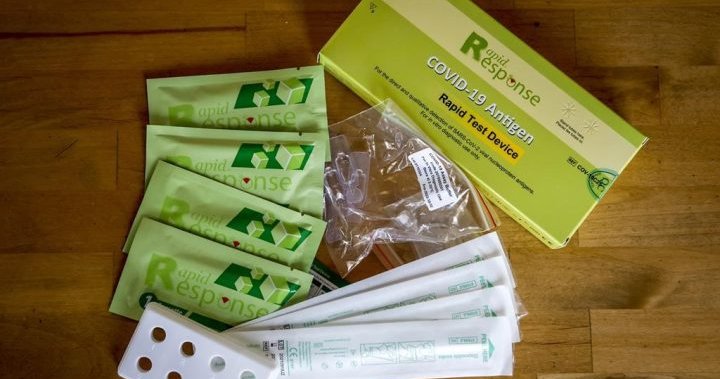
    The federal government has stopped shipping rapid COVID-19 antigen tests to provinces as millions are set to expire within the year, and experts say the once-essential tool has lost its importance in the pandemic.

    There are 90 million rapid tests in the federal inventory, Health Canada said in an email. About 80,000 of those are set to expire within six months and 6.5 million within the year. The rest expire within two years.

    “Canada has robust inventories and is well prepared for COVID response,” Anne Genier, with Health Canada, said in an email.

    Ottawa has ordered more than 811 million rapid tests since the beginning of the pandemic with a price tag of about $5 billion. About 680 million of those went to provinces and territories.

    Story continues below advertisement

    As the fourth wave of the pandemic gripped the country near the end of 2021, every region was trying to get as many of the tests as possible. Hospitals were overwhelmed in many provinces and the rapid antigen tests became a critical part of the response.

    Mahesh Nagarajan, a professor at the University of British Columbia’s Sauder School of Business, said it’s a different situation two years later.

    “I don’t think we should be buying any more of them right now,” Nagarajan, whose focus area is on supply chains, said in a recent interview.


    Click to play video: 'First at-home combination test for COVID and flu approved in U.S.'


    First at-home combination test for COVID and flu approved in U.S.


    Nagarajan said Canada now has several qualified and dependable suppliers for the tests. The government has established standing offers with the companies for the supply and delivery on an as-needed basis

    Health Canada said the decision to end shipments at the end of January was made in collaboration with provinces and territories, as the regions have enough supply.

    Story continues below advertisement

    On top of the federal stockpile, provincial health authorities said theyhave millions of tests.

    British Columbia has 28 million tests, with more than four million to expire within six months.

    Quebec has 63 million tests, Alberta has 47.5 million, Saskatchewan has 6.4 million, Manitoba has 11 million, Nova Scotia has about 8 million and Newfoundland has about 2.5 million.

    Nearly every region said they have so far not destroyed or repurposed their rapid antigen tests, because Health Canada extended the expiration date for many brands. They did not explain an expected cost or strategy if the tests expire before being used.

    The time frame left for the tests differs depending on the brand,but Health Canada has approved 19 extensions of shelf life ranging from six months to two years.

    The chemical components in the tests degrade over time, Nagarajan said, so he has concerns.

    “Rapid antigen tests to begin with are not the most accurate,” Nagarajan said. “Now you are extending their lifespan?”


    Click to play video: 'Quebec pharmacists set to stop handing out free COVID-19 rapid tests in March'


    Quebec pharmacists set to stop handing out free COVID-19 rapid tests in March


    Nagarajan said every country has stockpiles, but it’s important Canada learn from the pandemic procurement process.

    Story continues below advertisement

    A lack of co-ordinated policies across the country made it hard to estimate how many tests would be needed. It was a “recipe for high inventories,” Nagarajan said.

    Nazeem Muhajarine, a professor of epidemiology at the University of Saskatchewan, said he estimates that for every five tests given out by provinces and territories during the pandemic there are two tests sitting in a warehouse.

    He said Canada needed to procure as many tests as it could when they were available.

    “We have to have a plan _ that’s key.”

    Muhajarine said it is difficult to know how important the rapid antigen tests will continue to be, because there is very little communication now about COVID-19, let alone government plans to address challenges the pandemic may still bring.

    “That communication has really fallen off precipitously,” he said. “Nobody is talking about COVID, certainly not talking about where to get tests if they need one.”

    Having large stockpiles of rapid antigen tests may not be useful, especially if the virus shifts and becomes less detectable on the devices, said Dr. Anna Banerji, an infectious disease specialist at Dalla Lana School of Public Health and Temerty Faculty of Medicine at the University of Toronto.

    Story continues below advertisement

    “Even at the best of times there are limitations on the testing,” she said.


    Click to play video: 'Ontario government sitting on hundreds of millions in COVID-19 funding'


    Ontario government sitting on hundreds of millions in COVID-19 funding


    What is important is the ability to quickly produce or procure them, she added.

    Banerji said, in her opinion, people are using rapid antigen tests less because there is no longer a public health strategy to deal with COVID-19. She said people aren’t wearing masks and, in most instances, there is no isolation policy if someone actually tests positive.

    If you know you have COVID-19 and don’t do anything about it, there’s no point, she said.

    “Right now, there is no strategy. We are not looking at numbers. We don’t know how much COVID is out there,” she said.

    “What difference is (testing) making now?”

    &copy 2023 The Canadian Press

    Ontario growing pharmacists’ prescribing powers, eyes further expansion

    0

    Ontario is giving pharmacists additional prescription powers, and is considering allowing them to administer certain treatments and medications through injection.

    Two months after regulatory changes allowed Ontario pharmacists to prescribe treatments for 13 common ailments, Ontario announced Thursday in its budget that it is planning a further expansion.

    Health Minister Sylvia Jones had asked the Ontario College of Pharmacists earlier this month to draft regulations that would allow pharmacists to prescribe for mild to moderate acne, canker sores, diaper rash, yeast infections, pinworms and threadworms, and nausea and vomiting in pregnancy.

    The budget confirmed that the government would be giving pharmacists prescribing powers for those ailments.

    The Ontario College of Pharmacists said the minister had also asked the college’s minor ailment advisory group to explore adding even more ailments to the list and to prepare recommendations for this fall.

    Story continues below advertisement

    Justin Bates, the CEO of the Ontario Pharmacists Association, said prescribing allowed this year for the 13 common ailments, such as pink eye, hemorrhoids and urinary tract infections, has been a “fantastic success.”

    There have been 86,000 assessments and more than 70,000 prescriptions generated across the province so far, “which is much higher than we thought would be the case,” Bates said in a recent interview.

    “We’ve got the majority of pharmacists performing them and the public accepting that and using it as it was intended.”

    Even with the 13 common ailments, pharmacists in Ontario are still only allowed to prescribe for the smallest number of conditions, Bates said. Saskatchewan and Prince Edward Island have a list of 32 conditions, he said, and Alberta pharmacists have prescribing authority for all medications that aren’t controlled substances.

    “We are looking forward to an expanded list now that we’ve demonstrated the capacity of our sector to be able to do it and I think the acceptance of the public as well, as an additional channel to receive community-based care,” Bates said.

    A spokesperson for Jones said earlier this month that the government was considering expanding the scope of what certain health professionals, such as nurses, can do in periods of “high patient volumes.”

    Story continues below advertisement

    That list of health professionals also includes pharmacists, and spokeswoman Hannah Jensen said the ministry is looking at allowing pharmacists to administer certain substances by injection or inhalation.

    “Maximizing professional scopes to increase flexibility is a lesson learned from the COVID-19 pandemic and a key part in building a health-care system that is easier to navigate and provides Ontarians with access to faster, more convenient care, when and where they need it,” she wrote in a statement.

    The pharmacists’ college had actually submitted draft regulations to the minister in 2019 that would allow for the expanded injection scope, but they weren’t approved at the time.

    Bates said such injections would be shots other than immunizations, such as vitamin B-12 shots, or certain injectable antipsychotic medication, rheumatoid arthritis and osteoporosis drugs and birth control.

    &copy 2023 The Canadian Press

    Raccoon euthanized after it was brought to Maine pet store for nail trim

    0

    A juvenile raccoon in Maine was euthanized and tested for rabies after a woman brought it into a pet store for a nail trim and some customers kissed it, state wildlife authorities said.

    The raccoon tested negative for the disease, and there is no rabies risk to the public, Maine Department of Inland Fisheries & Wildlife spokesperson Mark Latti said Sunday. However, raccoons are one of the most common carriers of rabies in the state, and bringing the wild animal into a pet store constituted an unnecessary risk to public health, Latti said.

    The woman, who has not been identified by authorities, brought the raccoon into an Auburn pet store on Tuesday, the wildlife department said. She was seeking to get the animal’s nails trimmed, which is a service the store does not provide to raccoons, the department said.

    It is illegal to keep wildlife, including raccoons, as pets in Maine.

    Story continues below advertisement

    Several different people handled the animal, and some kissed it, the wildlife department said. The store’s manager then asked the woman to leave and contacted the Maine Center for Disease Control and Prevention, the department said.

    The raccoon was then tested for the disease, which came back negative, but necessitated euthanizing it, Latti said. There is no nonlethal test for rabies in animals, he said.

    Rabies is almost always fatal in humans once symptoms appear, and potential sufferers need to seek treatment immediately. Wildlife is best left alone, though animal control authorities can also be notified if the animals appear to be in distress, Latti said.

    “When they lose their fear of people they are more likely to become a nuisance or be run over by a vehicle,” Latti said.

    The wildlife department said store customers who touched the animal should still contact their health care providers as a precaution. Raccoons are capable of transferring other diseases along to humans and other animals as well.

    The pet store, a Petco location, did not immediately respond to a request for comment on Sunday. A representative for the local store referred a request on to the company’s corporate office in San Diego.

    The Maine Department of Inland Fisheries & Wildlife is currently searching for the unidentified woman who brought the raccoon to the pet store. The agency reminded Maine residents that it is illegal to possess wildlife and that they should never try to handle, feed or move a wild animal.

    Story continues below advertisement

    “If you care, leave them there,” the department wrote.

    It is illegal in Canada to keep a raccoon as a pet. In this country, 25 people in six provinces (Quebec, Ontario, Alberta, Saskatchewan, Nova Scotia and British Columbia) have died of rabies since 1924.

    — With files from Global News’ Sarah Do Couto.

    &copy 2023 The Canadian Press

    Dauphin mayor says outpouring of support appreciated

    0

    The mood remains sombre in Dauphin, Man., as area residents learn more details of the highway crash that killed 15 people and injured 10.

    Mayor David Bosiak says people are sad and the effect on the city and surrounding area will be multi-generational.

    He adds residents appreciate the support and condolences that have come in from across Canada, including from Prime Minister Justin Trudeau.

    The provincial health authority says 10 patients remain in hospital. Six are in critical care.

    A moment of silence was held ahead of the Canadian Football League game Friday night between the Winnipeg Blue Bombers and the Saskatchewan Roughriders.

    Bosiak says he expects a decision will be announced Monday on whether a formal vigil or other public event will be held.

    Story continues below advertisement

    A support centre for families of those involved in the crash will continue to run over the weekend at the community’s curling rink.

    RCMP are still investigating the fiery crash Thursday between a transport truck and a minibus that was carrying seniors from the Dauphin area to a casino near Carberry, Man., about two hours away.

    The truck was travelling east on the Trans-Canada Highway when the southbound minibus crossed at an intersection, RCMP said Friday.

    Investigators have not yet spoken with the driver of the bus, who remains in hospital.


    Click to play video: 'Manitoba crash: RCMP, provincial medical examiner offer update on crash investigation'


    Manitoba crash: RCMP, provincial medical examiner offer update on crash investigation


    &copy 2023 The Canadian Press