
spot_img
Thursday, April 16, 2026
More
    spot_img
    Home Blog Page 22

    Sask. auditor’s report flags issues around administrative segregation at correctional facilities

    0

    A report done by Saskatchewan’s provincial auditor saw the need to give recommendations to the Ministry of Corrections, Policing and Public Safety after an audit pointed out the inconsistency around inmate administrative segregation.

    The report, which was released on Tuesday, says administrative segregation is used at correctional facilities to keep inmates away from the general population for safety or security purposes, noting that inmates should not be segregated for longer than 15 days.

    An audit done between January 2021 and April 2022 found 13 inmates that had been in administrative segregation for longer than 15 days, with the longest being recorded at 43 days.

    The number of inmate placements on administrative segregation.


    The number of inmate placements on administrative segregation.


    Provincial Auditor of Saskatchewan

    “Unnecessary or prolonged segregation may leave vulnerable inmates with irreparable mental and physical health damage that may lead to higher healthcare costs (e.g., self-harm injuries) and, in extreme cases, to avoidable life loss (e.g., suicide),” the report read.

    Story continues below advertisement

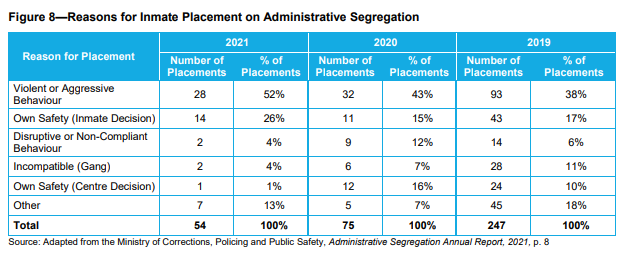
    It added that in 2021, there were 54 placements of 49 inmates on administrative segregation. There were 75 placements in 2020.

    Recommendations for the Ministry included developing a training plan for correctional staff involved in administrative segregation; having appropriate staff authorize administrative segregation decisions as well as properly completing reviews and assessments; broadening the quality assurance reviews; and enhancing written reports to senior management.

    The report looked over Saskatchewan’s four adult secure-custody correctional centres:

    • Prince Albert Correctional Centre
    • Regina Correctional Centre
    • Saskatoon Correctional Centre
    • Pine Grove Correctional Centre

    According to the annual report for the Ministry in 2021-22, it spent $171 million on custody services.

    The Ministry added that it had more than 1,800 inmates, with 44 per cent of them being sentenced and 56 per cent on remand.

    The Custody Services Unit had 1,873 full-time equivalent staff as of the end of March 2022.

    The auditor’s report noted that inmates could be placed on administrative segregation for things like aggressive or violent behaviour, non-compliant or disruptive behaviour, or at the request of an inmate for their own safety.

    Story continues below advertisement

    Reason for inmate placement on administrative segregation.


    Reason for inmate placement on administrative segregation.


    Provincial Auditor of Saskatchewan

    It noted that 20 inmate files on administrative segregation were reviewed in 2021, with three assessments being completed by inappropriate staff, and one assessment not documenting the reason for administrative segregation or the alternatives considered.

    The report noted that five of the inmate placements were not properly authorized, with all five cases being approved by a correctional officer instead of a correctional centre manager.

    “Not having appropriate staff completing and approving administrative segregation placement decisions increases the risk that inmates may be placed on administrative segregation inappropriately,” the report read.

    Other paperwork and communications, like signoffs that an inmate was verbally informed that they’d be placed in administrative segregation, reviews of administrative segregation, as well as health-care assessments, weren’t always completed, according to the report.

    Story continues below advertisement

    Recommendations around health-care assessments related to the completion of assessments and training for nurses on staff.

    The report said 20 inmate files were tested and found that some health-care assessments weren’t completed, or they were done three to seven days after the fact.

    It noted that some nurses were interviewed and found that there was a lack of understanding of when a health-care assessment was needed, with some nurses citing a review that no longer exists.

    The report said nurses do not receive refresher training on administrative segregation processes.

    The Ministry of Corrections requires correctional staff to meet with inmates daily and record the results of the meeting in the IT system. According to the report,  this is inconsistent, with one example given of an inmate being placed in administrative segregation for 24 days, but only eight daily reviews were recorded.

    Other provinces like Ontario give public information on their website regarding administrative segregation, like the number of placements, the length of the stay, as well as some demographic information. The auditor’s report suggests that the Ministry should start doing this.

    “Publicly reporting information about the use of administrative segregation would help the Ministry demonstrate its commitment to reducing the over-use of segregation, enhance accountability, and encourage oversight,” the report read.

    Story continues below advertisement

    &copy 2022 Global News, a division of Corus Entertainment Inc.
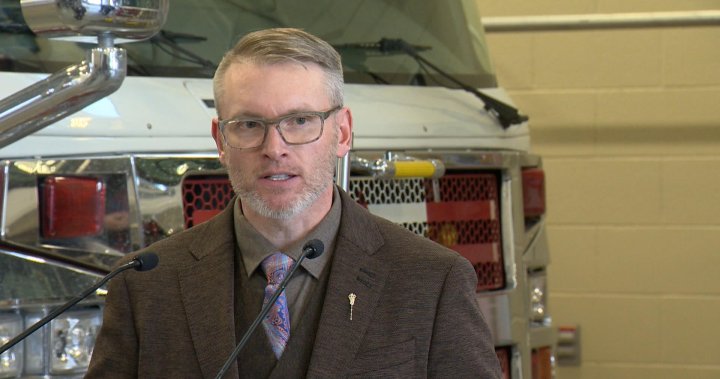
    Overdose outreach teams being implemented in Saskatchewan

    0

    Drug overdoses have been a major concern for Saskatchewan in recent years as the number of confirmed overdose deaths continue to rise in the province with few safe injection sites.

    As part of the province’s attempt to reduce the number of overdoses, The Saskatchewan Health Authority (SHA) is partnering with both the Saskatoon and Regina fire departments to develop overdose outreach teams.

    The teams are part of a pilot project to help individuals reduce their risk of overdose and other drug-related harms as well as help people access the support they need to recover and heal.

    “We have seen this overdose outreach team model used in other part of Canada as well as areas of the United States and felt that it would be another tool for us to have for overdoes in dealing with treatments and recovery,” said mental health and addictions minister Everett Hindley.

    Story continues below advertisement

    The overdose team consists of mental health and addiction counsellors from the SHA and primary care paramedics from Regina and Saskatoon fire services.

    The province said the team will provide counselling sessions with individuals as well as connect them to other agencies for long term care and attention.

    “We want to see a reduction of overdoses that are happening in our communities,” Hindley said.

    Regina fire and protective service chief Layne Jackson said the issue of overdoses is something that needs urgent attention in the city.

    “We have done prevention and public education in this community for many years whether it be at the schools or with Canadians, but this is about preventing,” Jackson said. “Preventing through education.”

    Saskatoon fire chief Morgan Hackle shares a similar view, and hopes the team provides a new level of support she said is desperately needed in the city.

    “The proactive collaboration of the overdose outreach team will be instrumental in provided coordinated support to those with addictions,” Hackle said.

    The province said the overdose outreach teams are one of the Saskatchewan Drug Task Force’s priorities and are part of the ‘hot-spotting approach’, a strategy to help direct resources to people at highest risk in specific geographic regions.

    Story continues below advertisement

    The Drug Task Force is providing $650,000 to fund hot-spotting initiatives, which includes $250,000 for the Overdose Outreach Teams pilot project.

    The pilot will run until May 15, 2023 in Regina and Saskatoon.


    Click to play video: 'Saskatchewan surgical backlog leaves patients in dire situation'


    Saskatchewan surgical backlog leaves patients in dire situation


    &copy 2022 Global News, a division of Corus Entertainment Inc.

    Most difficult time for pediatric ERs is now, Saskatoon doctor says

    0

    At the start of the COVID-19 pandemic Dr. Ben Thomson says he was scared he’d be treating unprecedented levels of kids who were sick with the virus.

    But that wave of sick kids didn’t materialize then.

    It is now.

    “Over the last few years of the pandemic, the most difficult for pediatric emergency has by far been the last eight or nine months,” Thomson told Global News.

    Thomson, the University of Saskatchewan pediatric emergency medicine division lead and a pediatric ER doctor, also said the influx of patients will probably get worse.

    “We’ve really just hit the beginning of it,” he said.

    Story continues below advertisement

    “And we are kind of buckling down for probably a few more months of pain.”

    Many children’s hospitals and pediatric departments across the country are filling up and strained.

    The Canadian Red Cross will be sending teams to Children’s Hospital of Eastern Ontario. And the Alberta Heath Services is discharging all children from a house that helps dying children and their families in Calgary because of a surge of children with COVID-19, RSV and the flu.

    Thomson said, as he understands it, the Saskatchewan Health Authority (SHA) is planning for how to get extra staff to help on the front lines.

    He said they haven’t had major issues with gaps so far.

    “But we can see in two weeks we’ve got shifts that are open,” he told Global News.

    “How are we going to fill those? How to incentivize those shifts? Is there anyone else we should be bringing on from the outside or general pediatrics who can help us out under the pediatric emergency umbrella?”

    Global News reached out to the SHA and asked if it anticipates having to reassign staff to help with a surge of sick kids and at what point that would begin.

    Story continues below advertisement

    Salma Sarhan is one of the parents who brought her children to Saskatoon’s ERs.

    In fact, she says she brought her one-year-old son to the ER four times in a matter of weeks.

    “I just cried. I couldn’t stop crying because I was so stressed,” she said.

    “My kids are sick. There is a shortage of all medicines that can make them better. And I have no idea what’s going on… then I just had to hold myself together because (I’m) the mom.”

    Sarhan said she remembers the date when her kids first got sick. It was Oct. 2.

    Sarhan said her oldest, her six-year-old daughter, had an eye infection. The six-year-old and Sarhan’s other daughter, a five-year-old, were fussy all night.

    At the same time, her son had a really bad fever and was shaking so hard Sarhan thought he was having a seizure.

    What followed, she said, was weeks of illnesses, ranging from infections, to allergic reactions to the medication to treat the infection, to the infant catching croup, to waiting more than 12 hours in the ER, to everyone, including the one-year-old, catching COVID.

    Story continues below advertisement

    It was only last week they were all healthy once again, Sarhan said.

    Sarhan said she’s thankful and hoping everyone can stay healthy.

    “Since the older kids went back to school in August, it has been non-stop with us,” Samantha Irvine said.

    Irvine, who runs a daycare in Regina, said her child or at least one of the five children she regularly takes care of has been sick since August until about two or three weeks ago.

    “I think all of the kids have had the stomach flu at least once in the last probably month,” she told Global News.

    She said her own kid was sick with a respiratory illness that turned into pneumonia while hers turned into a sinus infection.

    And she said she’s worked through nearly all of it, because she doesn’t have paid sick days.

    She said many of the parents of children she cares for ran out of sick days during the summer.

    “Pretty much as long as they don’t have a fever and they’re able to play,” they’d be there, Irvine said.

    Story continues below advertisement

    Epidemiologist Nazeem Muhajarine said kids always spread germs and the like when they play together.

    Children are among the least vaccinated, Muhajarine pointed out, since they became eligible for vaccines last. And now their vulnerability to RSV, combined with a flu season that started early, means what they may be spreading is worse.

    “I think it is going to last a little bit longer than the typical flu season would last (compared to) before the pandemic,” Muhajarine said, “because there’s so many pathogens that are circulating right now.

    Both Muhajarine and Thomson encouraged the use of masks and said it’s up to adults to mask in order to protect children.

    They both lamented how wearing a mask has become politicized.

    “What’s a little sniffle in an adult can actually be potentially life-threatening illness in a young baby or a child or an older person,” Thomson said.

    “And so leaving the politics of masking aside, if you have the tiniest tickle in your throat with the tiniest bit of sniffles, the responsible thing to do, in my opinion, is to be masking.”

    — with a file from the Canadian Press.


    Click to play video: 'Saskatchewan man calls for changes in organ donation for gay men'


    Saskatchewan man calls for changes in organ donation for gay men


    &copy 2022 Global News, a division of Corus Entertainment Inc.

    Saskatchewan man calls for changes in organ donations for gay men after late husband’s tissues disqualified

    0

    Saskatchewan resident Dwayne Belcourt is accusing the Saskatchewan Health Authority of discrimination because he says his late husband’s tissues were disqualified due to his same-sex relationship.

    On Aug. 30, Belcourt’s husband Merril Donkin died from stage four liver cancer.

    On the morning of his death, Belcourt said he received a call from the Saskatchewan Health Authority regarding tissue donations and was first told Donkin was a great candidate to be a tissue donor.

    An hour later, Belcourt said SHA called again.

    “They basically asked me if [Donkin] had intimate relations with a man in the last five years,” Belcourt explained.


    Merrill Donkin.


    Courtesy: Dwayne Belcourt

    Belcourt and Donkin got married in April 2022, but had been dating for over 20 years prior to their marriage. After confirming Donkin’s sexual history, Belcourt said he was upset to hear how the phone call had to end.

    Story continues below advertisement

    “After she confirmed that he had a sexual relationship with a man in the four or five years, that disqualified him. All his tissues were disqualified,” Belcourt recounted.

    “The fact that they called me the day of my husband’s death. To add that on top of that, I was quite upset,” Belcourt added.

    Belcourt believes the donor policy is bizarre given the recent blood-ban changes for gay men.

    “They’re advertising that we can give our blood, but they won’t take anything else,” he said.

    He is asking health officials to re-consider their rules for organ and tissue donations.

    Belcourt says the policy is discriminatory, especially if the SHA had confirmed in their initial phone call that Donkin was a viable donor.

    “You’re throwing away good, viable tissue or whatever you want to take from him because he’s a gay man and had sex with the man. And I asked ‘Did you ask that question for heterosexuals?’ And the answer was, ‘no.’”

    “They’re constantly complaining when they’re low on stuff: low on blood, Low on tissue, please go out and donate, and all sign up, and all this stuff. Right. Well, I find that kind of a contradictory advertisement, being that they’re throwing away good, good tissues or blood because we’re gay or we’ve had sex with a man,” Belcourt said.

    Story continues below advertisement

    Health Canada has a guidance document that lists reasons that may be used to determine a deceased donor’s risk of having a transmissible disease.

    Under the “Deceased Donors” section, an example that may be associated with the presence of a transmissible disease includes the following bullet point: “for a male donor, physical evidence of anal intercourse including perianal condyloma.”

    Global News reached out to Health Canada on the matter.

    In a statement, it said in part “These guidance documents are administrative instruments not having force of law and, as such, allow for flexibility in approach.”

    “In the case of diseased donors, the mandatory physical examination includes a recent antemortem or postmortem physical examination, a directed physical examination and may include a limited autopsy, if performed. The directed examination should include any of the applicable items included below that would assist in determining whether there is evidence of high-risk behaviour,” the statement read.

    Organ and tissue donations are under provincial jurisdiction and are overseen by the Saskatchewan Health Authority.

    Story continues below advertisement

    The SHA began its statement in consultation with Dr. Alastair Wall, medical director and co-lead of the Saskatchewan Organ Donation Program (SODP), saying it would never deter organ donations based on sexual orientation for non-ocular (or life-saving) organ donations.

    However, it said ocular organ donations are considered non-life-saving transplants and have more strict screening criteria that may defer a donation based on medical and/or social history.

    “They will be subject to individual assessments by virtue of the organ they are donating, which may entail more detailed screening. Risk assessments are then based on the data points within the clinical profile of the donor and the recipient,” the statement read in part.

    While the SODP acknowledges that Health Canada is reviewing these guidelines, it said it is following federal recommendations.

    “The transplant program will continue to base its screening protocols on current federal guidelines. Health Canada and Canadian Blood Services screening guidelines and criteria include questions regarding whether the donor is a man who has had sex with other men,” the statement said.

    The statement included a message from Dr. Vikas Sharma, medical director for the Saskatchewan Organ Donation Program.

    “It’s not about discrimination, and that is not the intent of the current screening standards,” Dr. Sharma said.

    Story continues below advertisement

    “The ability to more accurately, and quickly test donor tissue for disease before transplant is currently limited, making screening a vital component for patient safety under difficult and time sensitive circumstances. Screening for ocular transplant focuses on mitigating repercussions of a chronic disease being passed to a recipient. The current guidelines are in place based on research and clinical evidence. As research continues to evolve and national standards are adapted, SODP screening practices will also evolve to stay in alignment,” Dr. Sharma said.

    For Belcourt, he wants to see change.

    “I really feel that the SHA really needs to step their game up. I really feel that they’ve failed in more ways than one, not just my husband,” Belcourt said.

    Belcourt said an equitable approach to the screening process is needed.

    He is considering taking legal action after seeking advice from a lawyer.

    &copy 2022 Global News, a division of Corus Entertainment Inc.

    Sask. needs to improve health-care hiring plan as 2,200-worker shortage looms: auditor

    0

    While she says Saskatchewan’s Health Human Resources Action Plan is a step in the right direction, Saskatchewan’s provincial auditor says enhancements are needed to ensure accessible health care.

    According to her latest report, released Tuesday, the Saskatchewan Health Authority is projecting a shortage of 2,200 “hard-to-recruit” health-care workers over the next five years.

    “At the end of the day, we’ve made recommendations. They’re going to have to do more than the status quo,” Tara Clemett said at the legislature Tuesday.

    Story continues below advertisement

    “What we would like to see them do is better identify targeted plans in terms of what are the root causes that perhaps they have difficulties. What do they need to do to get people to want to work in rural and remote Saskatchewan?”


    Saskatchewan Provincial Auditor

    Specifically, the SHA is projecting a need for 840 continuing care assistants, 180 medical laboratory technicians and 520 registered nurses.

    “We have emergency rooms, we have lab services that aren’t available to the people of Saskatchewan because we don’t have the staff to deliver those services,” Clemett said.

    “This is why ERs are not open all of the hours they should be or are closed in totality, because we don’t have registered nurses in various parts of the province.”

    Story continues below advertisement

    Sask. needs to improve health-care hiring plan as 2,200-worker shortage looms: auditor - image


    Saskatchewan Provincial Auditor

    Clemett made seven recommendations in her report.

    Among them is a recommendation to “determine the optimal supply of new graduates needed to help address staffing shortfalls.”

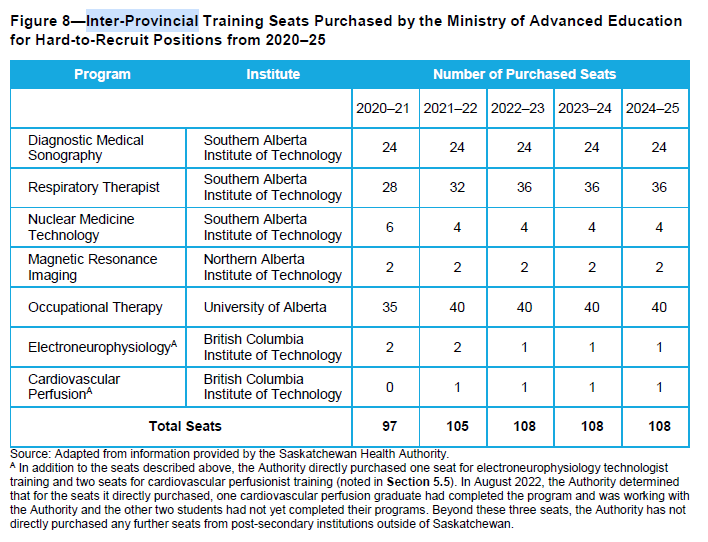
    “Sometimes the government’s paying for training out of the province. They don’t actually know if those people are coming back to Saskatchewan,” Clemett said.

    “With staff exit interviews, they don’t know why people are leaving and if there’s something they can be doing better to keep them here.”

    Clemett is also recommending establishing a First Nations and Metis recruitment and retention plan.

    “Are there housing options? Is there spousal employment that can be provided?” Clemett asked.

    Story continues below advertisement

    “The focus can’t just be about getting more people into Saskatchewan. It’s about retaining the current workforce the Authority has as well. What can be done to make them stay?”

    Sask. needs to improve health-care hiring plan as 2,200-worker shortage looms: auditor - image


    Saskatchewan Provincial Auditor

    Speaking Tuesday afternoon, Opposition Leader Carla Beck said the report didn’t come as a surprise.

    “It is deeply concerning that we are losing 600 more health-care workers than recruiting right now,” she said, referencing another statistic in the report showing that in 2021-22 the SHA had about 3,500 new hires and about 4,100 terminations.

    “The insufficiency of the plan that the government is holding up as the Holy Grail to health care, I think this confirms what health-care workers and communities are telling us that it’s inadequate and not working.”

    Story continues below advertisement

    Health Minister Paul Merriman, newly returned from a health care hiring mission in the Philippines, expressed confidence in his government’s plan Tuesday.

    “We’re starting to see some of the results of that,” he said.

    “Recruitment in the Philippines went extremely well – 129 offers were made to individuals, and these are individuals who are extremely excited to come to Saskatchewan.”

    Merriman said, though, that the province accepts all of the Auditor’s recommendations.

    “We’re going to fill all the positions that we need to fill,” Merriman said.

    &copy 2022 Global News, a division of Corus Entertainment Inc.

    Liquid antibiotics the next drug to disappear during Sask. medication shortage

    0

    After parents endured a children’s acetaminophen and ibuprofen shortage, there are more tough times ahead as liquid antibiotics are now becoming scarce in Saskatchewan. Commonly prescribed to cure children’s infections, pharmacists are calling it a “tier three shortage” meaning it’s critical.

    “This had a big impact on the health-care system,” said pharmacist Kelly Kizlyk.

    “Drug shortages are complex. There are a lot of factors that contribute o why we have drug shortages … one of the reasons they’ve called a tier three shortage is it really allows the government to do all sorts of things in order to access a safe supply of medications. And so really, we’ve got government, we’ve got the supply chain, we’ve got health-care professionals – pharmacists, physicians, nurse practitioners – all involved in helping to manage this drug shortage.”

    Story continues below advertisement

    The Ministry of Health said that supply chain issues are not unique to the province or even Canada right now.

    “As is the case across the country, Saskatchewan is experiencing supply challenges in a number of areas, including some medications. The antibiotic, amoxicillin, is currently in reduced supply not just in Canada, but globally,” said representative Dale Hunter on behalf of the Ministry of Health.

    He says that this is largely due to increased demand during the flu season. They are working with pharmacists, so they are able to provide their clients with alternative options to liquid antibiotics.


    Click to play video: 'Critical shortage of liquid antibiotics: Healthy Living'


    Critical shortage of liquid antibiotics: Healthy Living


    Kizlyk said that determining symptoms and whether an ailment is worthy of doctor or emergency treatment is the first step for parents treating their kids. She said access to nurses by calling 811 can help parents determine what kind of infection their child might have.

    Story continues below advertisement

    “We can have that conversation about what needs an antibiotic and what doesn’t need an antibiotic. Right now, we’ve got lots of viruses circulating, so we’ve got COVID, we’ve got influenza, we’ve got RSV. These viruses are not touched by antibiotics. So, antibiotics kill bacteria. And although there are some infections that need an antibiotic, not all infections do. And this is a really important point for parents and caregivers to realize,” Kizlyk said.

    The current shortage of antibiotics involves the liquid version, meaning capsules and tablets are readily available. Whether it’s an adult that has trouble swallowing pills or a child, pharmacists are coaching people through options so they can use solid versions of the medication.

    “So, I know with some of these antibiotics and even the ibuprofen and acetaminophen, we’ve been coaching kids that are ready on how to swallow pills. And there’s some awesome tools on the internet,” said Kizlyk. “You might be able to open that tablet or capsule or crush it and administer it to your child.”

    The Government of Saskatchewan said with “the recent increase in influenza and respiratory illness activity it is imperative that all residents get up-to-date on their vaccinations and get their flu shot. All preventative measures that prevent COVID-19 transmission will also mitigate the transmission of other respiratory illnesses, including influenza.

    Story continues below advertisement

    “Health Canada recently approved the importation of ibuprofen and acetaminophen from the U.S. and Australia for use in hospitals, as well as additional foreign authorized children’s acetaminophen for sale at retail and community pharmacies.”

    This is an option that is being explored once again for the importation of antibiotics.

    &copy 2022 Global News, a division of Corus Entertainment Inc.

    Provincial auditor’s report flags critical condition of Saskatoon hospitals, care facilities

    0

    Saskatchewan’s provincial auditor followed up on recommendations made back in 2019 to health-care facilities in Saskatoon and the surrounding area, noting that only a couple of the ten recommendations were implemented, and that maintenance was needed for worsening conditions.

    The auditor’s report, which was released Tuesday, said two recommendations were implemented, seven were partially implemented, and one recommendation had no progress made as of July 2022.

    It noted that the Saskatchewan Health Authority (SHA) reported regularly to senior management about maintenance activities, and that facility conditions are formally assessed, with the last formal assessment in 2020, and a Building Operations Maintenance Plan was in development.

    But the report said the formal assessment indicated that facility conditions overall in the Saskatoon and surrounding area were in critical condition, and worsening.

    Story continues below advertisement

    “Not completing timely maintenance increases the risk that an asset may fail and cause harm to residents, patients, visitors, or staff,” the report read.

    According to the SHA annual report, the organization spent $75.1 million on repairs and maintenance expenses in 2021-22, with an additional $126.8 million spent on additions to buildings and improvements, as well as in-progress construction.

    The report said there are at least 50 health-care facilities in the city of Saskatoon and surrounding area that serve more than 360,000 people in some 100 communities.

    SHA owns 30 of those facilities, with the remainder owned by affiliates. SHA isn’t required to maintain affiliate facilities, but may do maintenance upon request.

    Saskatoon and the surrounding area have 10 hospitals, 29 long-term care facilities, 18 health centres and other health-care facilities.

    The report said a facility condition index (FCI) measures the condition of health-care facilities, determining whether the condition of a facility is good, fair, poor, or critical.

    Any facility measuring 30 per cent or more on the FCI is considered critical. In 2019, the average FCI for the area was 50 per cent; as of July 2022, that average had risen to 62 per cent.

    Story continues below advertisement

    One of the facilities in that category was considered good, two were considered fair, three were considered poor, and the remaining 46 were labelled as critical as of July 2022.


    A list of the facilities in Saskatoon and the surrounding area.


    Provincial Auditor of Saskatchewan

    The report noted that SHA had not established a measurable service objective.

    It added that as per the auditor’s recommendations, information in the maintenance IT system for facilities in Saskatoon and the surrounding area was updated, but user access wasn’t restricted to facilities that the users are assigned to maintain, nor was there a system to track changes users make to facility and component information.

    SHA said it was in the process of getting a third party to design a new maintenance IT system which is anticipated to be in place by the end of March 2024.

    The report also pointed out the inconsistency of preventative maintenance activities, giving the example that preventative maintenance for beds ranges from inspections every month to every two years.

    Story continues below advertisement

    According to the report, the SHA was developing a Building Operations Maintenance Plan, the draft of which included measures to make preventative maintenance a more consistent and standardized thing.

    Another recommendation from the auditor stated that planned maintenance activities could be used to help set the maintenance budget, but the report noted that SHA hadn’t yet implemented anything.

    The report said that the maintenance budget was built using historical data which limits the ability to accurately predict the cost of maintenance.

    &copy 2022 Global News, a division of Corus Entertainment Inc.

    ‘We can’t negotiate with ourselves’: Scott Moe calls for meeting at premiers’ news conference

    0

    Canada’s premiers met with each other virtually on Friday after discussions revolving around health-care with the federal government ended in a stalemate.

    Calls have been made by the premiers for the federal government to up its share of health-care funding to 35 per cent from 22 per cent.

    Saskatchewan is one of the many provinces in Canada struggling to keep up with health-care demand.

    Doctors like Dr. Ben Thomson say they are seeing unprecedented levels of sick kids, the provincial auditor wrote a report about the critical need for maintenance at health-care facilities in Saskatoon, and residents like Matt Temple are living through a parent’s nightmare – his sick one-year-old son is hooked up to ventilators and has been in the hospital for two weeks.

    Story continues below advertisement


    Click to play video: 'Surge of sick kids prompts calls for mask mandate return'


    Surge of sick kids prompts calls for mask mandate return


    Manitoba Premier Heather Stefanson started the meeting, calling for the premiers and the prime minister to meet early in the new year to discuss funding for health care.

    Saskatchewan Premier Scott Moe said the current health-care cost-sharing arrangement with the federal government is not sustainable.

    “At 22 per cent federal funding, 78 per cent provincial funding, I’d just put forward that’s not sustainable moving forward and the health-care cost-sharing, investment-sharing arrangement that was brought forward a number of decades ago was never anticipated to be with this small of the federal share,” Moe said.

    He said services need to be sustainable moving forward, noting that the federal government committed to raising the Canada Health Transfer.

    Story continues below advertisement

    Moe said compensation is needed to maintain the current human resources across Canada, but said that’s only a part of how they’ll increase the number of people offering health-care services.

    He noted that health-care training seats have been expanded in Saskatchewan, and he also touched on Minister of Health Paul Merriman’s trip to the Philippines to recruit nurses.


    Click to play video: 'How ER closures across Canada are leaving people vulnerable'


    How ER closures across Canada are leaving people vulnerable


    Last month, the federal government withdrew from a joint communique on health funding with provincial and territorial health ministers at a meeting in Vancouver.

    Federal Health Minister Jean-Yves Duclos said at the time that he went to the meetings “in good faith” but blamed premiers for giving their ministers “marching orders” to force negotiations to end with no deal after the premiers released a statement he says depicted the talks as a failure.

    Story continues below advertisement

    “It was reported that ministers had walked away from an offer that was made by Minister Duclos, there was no offer made by Minister Duclos,” Moe said.

    He noted the only offer that has been made is one made over two and a half years ago for the premiers to sit down with the prime minister regarding health-care funding.

    “We can’t negotiate with ourselves as 13 premiers as to what the federal share should be. We need the federal government at that table.”

    — with files from Nathaniel Dove and The Canadian Press

    &copy 2022 Global News, a division of Corus Entertainment Inc.

    Saskatchewan health-care shortages putting ‘patients at risk,’ doctors say

    0

    Concerned physicians in Saskatchewan are pointing out all the pressures the health-care system is dealing with.

    Dr. John Stempien, the provincial head of emergency medicine in Saskatchewan, says emergency department beds at the Royal University Hospital in Saskatoon are full.

    Stempien says the hospital has about 45 beds in the emergency department and will be filled with people normally taking up a bed in the upstairs wards.

    He said this has been an issue stretching into other hospitals and has been going on for months now.

    “So when we have either an admitted patient or a consulted patient those beds are no longer available to the emergency physicians to see patients. So, for us it’s a patient safety issue,” Stempien said.

    Story continues below advertisement


    Click to play video: 'Code Blue: No quick fix amid staffing shortages, surgical backlogs in Canada’s healthcare system'


    Code Blue: No quick fix amid staffing shortages, surgical backlogs in Canada’s healthcare system


    He said he’s concerned they can’t give the proper level of care to patients.

    “It puts those patients at risk and is extremely hard on the emergency physicians and nurses who are trying to do their best and care for every patient.”

    Stempien also noted instances of rudeness and sometimes violence aimed at front-line workers.

    “I think there’s been a slow but steady increase in a level of impoliteness or almost violence directed against some of our front-line staff, which has been very difficult as well.”

    Stempien said because of respiratory illnesses, hospital numbers are up, but added that the measurement of how sick patients are coming into the hospital is also higher.

    He noted that could be for a number of reasons, adding that people could be holding back from going to the hospital because they know ERs are busy, or it could be because people are having trouble accessing family doctors.

    Story continues below advertisement

    Residents in Saskatchewan have been struggling to find family doctors, with some being left to hunt for a doctor for several months.

    Dr. John Gjevre, president of the Saskatchewan Medical Association, said the province has experienced a movement of physicians “for a variety of reasons.”

    “I suspect it’s common, normal movement. There was, of course, a drop in movement during the start of the pandemic,” Gjevre said.


    Click to play video: 'After years of frustration, Regina doctor closing clinic doors'


    After years of frustration, Regina doctor closing clinic doors


    He added that the health-care system was static for a period of time, but said there are more opportunities for physicians to move now.

    Gjevre noted that there is an overarching issue, however.

    Story continues below advertisement

    “Clearly there is a crisis in primary care. And this is not just a Saskatchewan problem, it’s a national problem.”

    He said there’s a lack of family physicians across the country, noting that the reasons are complicated.

    Gjevre said part of the issue is fewer medical students are going into family medicine residencies, and some physicians during the pandemic have been burnt or retired early.

    He said he wants to work with the government to rebuild the foundation of health care.

    “Family medicine is the foundation for health care, and without that foundation, the rest of the structure becomes very shaky.”

    “Ideally everyone has a family physician, and everybody has health care close to home,” Gjevre added.

    Gjevre noted there have been talks with the government to address health care, which include trying to find new and innovative ways to provide care.

    He gave an example of a team-based approach where a family physician helps a patient find the health care they need, whether that be a social worker, a physiotherapist, a surgeon or a pharmacist.

    Story continues below advertisement

    Gjevre said it would be a variety of other health-care providers working with a family physician to “optimize health care for the patient.”

    He said this is a concept that’s been spread across Canada and works in other jurisdictions.

    Gjevre said an IT process that works across the province and is accessible to all health-care providers would be very helpful as well.

    “If you see an ear doctor in Lanigan, and they put something into the chart, and then you’re seen by a specialist in Regina, they have access to that.”

    He said a similar process already exists in Alberta, but added that they could improve upon that.

    Global News reached out to the Saskatchewan Health Authority for comment and received the following statement:

    “Saskatchewan is following and monitoring the situation across the country and monitoring the impact here in the province. Response plans are being readied to ensure Saskatchewan hospitals are prepared to meet the needs of children and families should we experience the same level of surge occurring in other provinces,” the statement read.

    “Seven additional beds, five in the Jim Pattison Children’s Hospital and two in Regina General Hospital, have been staffed to increase access to care for children. We have also added incremental care staff at peak times into areas that are seeing increased utilization, such as the Jim Pattison Children’s Hospital Emergency Department.

    Story continues below advertisement

    “The Saskatchewan Health Authority aims to ensure that every child, regardless of need or geography, has access to timely and appropriate care.

    “To date, our planning and preparation aim to increase access to acute care without impacting other child health programs. Slowdowns will be a last resort in the planning phases. This includes ensuring teams in rural Saskatchewan, Saskatoon, Prince Albert and Regina are all prepared and working together in a supportive network.”

    &copy 2022 Global News, a division of Corus Entertainment Inc.

    Staffing issue spurs Fort Saskatchewan hospital to temporarily close its obstetrics unit again

    0

    Staffing issues have once again prompted Alberta Health Services to temporarily close the obstetrics unit at a hospital northeast of Edmonton.

    In a news release issued Friday, the health authority said the unit’s closure at the Fort Saskatchewan Community Hospital is “due to the absence of obstetrician — regular and on-call — coverage.”

    “Pregnant women who planned on delivering at Fort Saskatchewan Community Hospital have been informed by their care provider in order to adjust their birth plan to deliver at the Sturgeon Community Hospital (in St. Albert),” AHS said. Plans are in place to support any labouring patient who presents to the site and needs to be transported to Sturgeon Community Hospital.

    “AHS apologizes for any inconvenience this might cause.”

    The health authority said pregnant women who need non-emergency medical care are encouraged to call their family physician or obstetrician.

    Story continues below advertisement

    “To speak to a nurse and receive telephone advice and health information, families can also contact Health Link 24/7 by dialing 811,” AHS said.

    READ MORE: Fort Saskatchewan Community Hospital temporarily closing obstetrics unit for 2nd time

    A lack of specialists prompted the Fort Saskatchewan hospital to temporarily close its obstetrics unit on two occasions this summer.

    Last December, the hospital also suspended its labour and delivery services for pregnant women because of staffing shortages resulting from the COVID-19 pandemic.

    READ MORE: Fort Saskatchewan hospital suspends services for pregnant women due to COVID-19 impact on staffing

    In an email, Fort Saskatchewan’s mayor told Global News via email that the community “is disappointed that once again our hospital birthing centre will be closed due to staffing issues.

    “AHS needs to find a resolution as this can’t continue,” Gale Katchur wrote. “It’s a stressful enough time for expectant mothers, and having to be redirected to another birthing centre outside out community that they are unfamiliar with is unacceptable.”

    READ MORE: Alberta nurses leaving front-line healthcare for less stressful units, jobs

    AHS noted that the Fort Saskatchewan’s hospital’s emergency department is still open and that people who need urgent and immediate medical care should still phone 911.

    Story continues below advertisement


    Click to play video: 'Alberta Children’s Hospital cuts some services to deal with surging flu cases'


    Alberta Children’s Hospital cuts some services to deal with surging flu cases


    &copy 2022 Global News, a division of Corus Entertainment Inc.