The Saskatchewan government is not considering decriminalizing any illicit drugs at this time, but the conversation is continuing among authorities and advocates in the province as a pilot project gets underway in B.C.
Beginning Tuesday, B.C. will start a three-year trial to test the effects of drug decriminalization in the province.
The First Nations Health Authority (FNHA) in B.C. says on its website that people 18 years of age or older will be able to possess a cumulative amount of 2.5 grams of certain illicit drugs without fines, arrest or seizure.
“B.C. gets to be the guinea pig, if you like, for this pilot project with the federal government,” Saskatchewan Minister for Justice Bronwyn Eyre said in December 2022 after the plan was announced.
Story continues below advertisement
The drugs being decriminalized in B.C. are opioids, including heroin and fentanyl, cocaine, methamphetamines and MDMA (ecstasy), with the FNHA noting that these are the drugs that are poisoned in B.C.’s toxic drug supply.
B.C.’s goal is for this to reduce shame and stigma surrounding drug use so people can feel more comfortable seeking help.
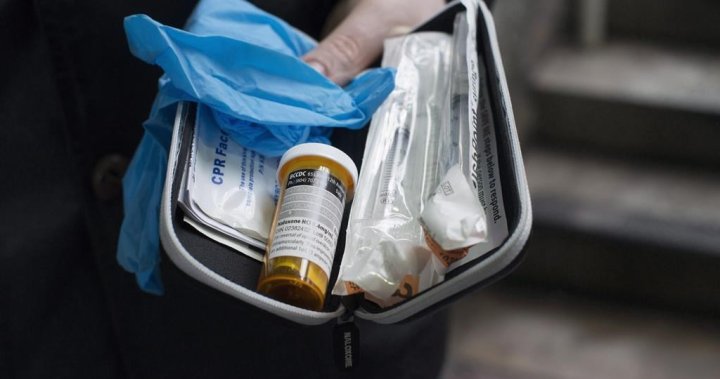
“This will mean that many people are likely to be more open about their substance use, talk about it with friends, families and care providers, and feel like they do not have to hide their use – and use alone, where no one is available to provide naloxone or call for help,” FNHA’s website reads.
The government of Saskatchewan confirmed in a statement to Global News on Tuesday that it is not considering criminally exempting any drugs like methamphetamine or cocaine.
“It is unknown what potential long-term effects that decriminalizing illicit drugs will have with regards to public safety,” read the statement.
“The Government of Saskatchewan’s focus continues to be on funding programming and services to help individuals experiencing addictions issues and providing pathways to treatment.”
Saskatchewan Minister of Health Paul Merriman was asked for his reaction to the trial several times at a press conference on Tuesday. He said that decriminalization is not being considered in Saskatchewan and passed the question off to Minister of Mental Health and Addictions Everett Hindley.
Story continues below advertisement
“It’s not on our radar right now,” said Hindley. “We are focused here on treatment and recovery and the additional investments we have made towards harm reduction.
“Ultimately, we want to make sure that we are providing to people access and avenues to long-term treatment and recovery.”
B.C. confirmed that this does not mean that drugs are legalized.
“The drugs covered under this exemption remain illegal,” the province said in a release. “The selling (or trafficking) of controlled substances remains illegal under the Controlled Drugs and Substances Act, regardless of the amount.”
Saskatchewan Association of Chiefs of Police president Rick Bourassa said that while there are no plans to decriminalize drugs in the province, it has been a conversation among authorities.
“We support it as long as the appropriate resources and supports are in place to make it successful,” said Bourassa.
He explained that if a similar trial were to be considered in Saskatchewan, police and authorities would look at the consequences of addictions in the community.
“One of the metrics that we would be looking at is the harms in terms of death in our province.”
Executive director Kayla DeMong of Prairie Harm Reduction in Saskatoon said she hopes this is a move in the right direction for the country.
“It will be really interesting to see what happens on the justice side of things as far as if people will still continue to be harassed and arrested,” said DeMong.
DeMong feels strongly that decriminalization should be implemented across the country.
“Decriminalization has been shown in other countries to be incredibly beneficial and have huge impacts on the justice side of things and the social side of things.”
She said she has heard the topic being discussed locally in Saskatoon but wishes it would extend across Canada.
“We wish them all the success in the world that this is a successful program, and we will be speaking with them and learning from it as we move forward,” Bourassa said.
“It’s a conversation that needs to continue.”
Story continues below advertisement
Officials hope B.C.’s drug decriminalization plan will reduce stigma around drug use
— with files from Global News’ Brody Langager, Amy Judd and Kristen Robinson
She didn’t expect it. Her doctors told her she was palliative and for years she had less than one per cent kidney function.
She had a transplant surgery booked in September 2021 but, barely a week after securing the date, the Saskatchewan Health Authority (SHA) postponed her operation – along with thousands of other surgeries so they could reassign staff amid COVID-19 pressures on the health system.
Bailey finally received the transplant last November, nearly four years after she was first diagnosed with kidney failure.
“(I) didn’t think it was going to happen, for the struggle that I was going through,” she said. “There’s not even a word for it. It’s just like you’re basically getting your life back.”
Story continues below advertisement
A new report shows that’s happening for more and more people, with the number of organ transplant surgeries approaching 2019 levels after the COVID-19 pandemic delayed so many, by “(placing) an unprecedented burden on health care systems in Canada and around the world.”
According to the Canadian Institute for Health Information (CIHI), 2,750 solid organ transplants were performed in Canada in 2021, which is only eight per cent less than the 2019 amount.
The amount of dead and living donors is also rebounding.
“There’s certainly an impact and one that I expect to continue to have a catch-up period,” CIHI researcher Nicole De Guia said, adding that the numbers don’t capture people who need organs but who weren’t on waitlists.
The report, which gathers information from provincial health and transplant organizations, says 1,673 kidney transplants took place nationally in 2021, with 3,060 people still waiting for the procedure.
And it found that 105 people died waiting.
“Although we’re approaching the pre-pandemic (levels), it’s just clear that there’s a lot more work to do because we want to continue to increase and meet the demand,” De Guia said, speaking from Toronto.
Story continues below advertisement
CIHI’s findings also show Saskatchewan lagged behind the national figures. Where the country collectively had seven per cent fewer surgeries in 2021 compared to 2019, Saskatchewan had 45 per cent fewer surgeries.
“These are data, De Guia said, “but they’re critically ill patients and (the delay) impacts on their families and support systems as well.
“So really… we still have a long way to go.”
Global News asked the SHA how many people are waiting for kidney transplants and if the Health Authority had cleared the COVID-19 surgery backlog.
They did not answer by publication deadline.
Green Shirt Day continues to grow and bring awareness to organ and tissue donation
Jessica said she was very lucky to survive her kidney failure.
Her health deteriorated after her surgery was postponed. She was on dialysis and suffered a hematoma (a pooling of blood in her body) and caught COVID-19. She struggled to get healthy enough to receive the organ.
Saskatchewan says efforts to recruit health-care workers are working as the province has made over 160 job offers to Filipino health-care workers to date.
The efforts have come through the province’s Health Human Resources (HHR) Action Plan to recruit, train, incentivize and retain health-care professionals.
In a release, Saskatchewan Health Minister Paul Merriman said that sustained work continues under the four pillars of the province’s HHR Action Plan.
“I am pleased to see steady progress in all areas of focus,” Merriman said. “As we start a new year, I look forward to more actions to build on the successes we have had so far. It’s important we continue to spread the word that Saskatchewan is an outstanding place to build and grow your health-care career.”
Story continues below advertisement
The province stated that registered nurses (RNs) from the Philippines received conditional offers who have begun working their way through the RN Pathway, which includes language, bridging education and licensing. Saskatchewan continues to progress by creating more permanent full-time positions and attracting health professionals to high-priority positions in rural and remote areas across Saskatchewan.
According to the statement, the Saskatchewan Health Authority (SHA) has hired more than half of the new full-time and enhanced part-time to full-time permanent positions posted, with over 90 of those positions now filled.
“It’s encouraging to see our competitive Rural and Remote Recruitment Incentive financial packages are generating interest and we are making progress in attracting health-care candidates in rural and northern communities throughout Saskatchewan,” Rural and Remote Health minister Everett Hindley said.
“Our province has a lot to offer to those interested in training and working in health care, from recent graduates to experienced health professionals. These health professionals will begin a new job and build their career within these communities and will also grow strong connections and enhance their lives with the rewarding experiences Saskatchewan communities of all sizes have to offer.”
The province said that there are more opportunities available to connect nursing graduates with job offers.
Story continues below advertisement
“Of the 78 graduates from the December cohort, 68 students have submitted their expression of interest to the SHA for the Grad Nurse Expression of Interest initiative that matches graduates with an area based on skills and preferences,” according to the release. “As of January 18, 2023, 29 students have accepted conditional job offers.”
The HHR Action Plan also includes First Nations and Metis recruitment and retention initiatives. One initiative includes the Indigenous Birth Support Worker program which is a partnership between the SHA and The Gabriel Dumont Institute, that offers 12 seats for an eight-week program commencing March 2023. Recruitment and retention engagement sessions with a number of First Nations, Tribal Councils and Metis Nation-Saskatchewan were held in November, December and January.
Progress continues under each of the four pillars of Saskatchewan’s HHR Action Plan, which are recruiting, training, incentivize, and retain. The province said that its $60-million HHR Action Plan, announced in September 2022, will add more than 1,000 health professionals into the health system over the next few years.
Almost 60% of Saskatchewan nurses considered leaving profession in past year, survey shows
After giving birth to her son on April 18, 2021, 38-year-old Jennifer Ferger in Victoria, B.C., had difficulty producing breast milk.
“We were concerned about my supply,” she told Global News in an interview this week.
After consulting with her midwife, she was given a number of choices, including herbal remedies and lactation cookies, to help increase production.
Finally, she settled on starting a prescription drug called domperidone recommended by her midwife.
“I wanted to give it the best shot I could, to provide breast milk,” she said.
While domperidone has been officially approved by Health Canada for treating gastrointestinal disorders since 1985, it is also sometimes prescribed postpartum to help increase the supply of breast milk.
Story continues below advertisement
Domperidone “antagonizes” dopamine, which allows for prolactin — the body’s milk-making hormone — to rise and increase milk production, said Jessica Bawden, a nurse practitioner at the Women’s College Hospital and an international board-certified lactation consultant, in an interview with Global News earlier this week.
However, as noted by Health Canada, domperidone is not authorized for use in the country for the purpose of increasing lactation. A side-effect of domperidone is increased breast-milk production, Bawden said.
Although off-label drug use — where a drug is prescribed for something that it wasn’t intended for or approved for — is a very common practice, using domperidone to stimulate lactation should be the last resort, Bawden added.
B.C. woman talks ‘withdrawal’ symptoms after going off domperidone
People who breastfeed should only take domperidone when they have “exhausted all of the first line ways of increasing milk supply” that are known, she said.
Story continues below advertisement
Kim Smith, international board-certified lactation consultant, who’s been in the field for 12 years, told Global News that domperidone is “fairly common” in her practice.
“But we still don’t universally know who’s going to benefit and who’s not,” Smith said.
“So, it’s often a just give it a try. And if it works for you, great. And if it doesn’t, then you know, then it doesn’t. And so, I have seen very mixed results.”
Studies published in the Canadian Medical Association Journal suggest the use of this drug to boost breastfeeding increased from the early 2000s through 2017.
For Ferger, she was assured by her midwife that the drug was commonly used and that she had prescribed it “many times before.”
Story continues below advertisement
“I was told it was completely safe and normal,” she said.
Though a maximum dose of 30 mg of domperidone per day is recommended by Health Canada — for gastrointestinal issues — Ferger’s dose was tripled, as her midwife prescribed her 90 mg per day.
Her breast milk supply tripled during the three months that she was on the drug but “it was a very difficult time,” she recalled.
By month three, Ferger started to have digestion issues and her mental health started to suffer as well. She decided it was time to switch to formula feeding and get off the drug.
“I didn’t feel good, I didn’t feel good, mentally. It just made things worse and made me feel gross. I was not doing well,” she said.
New study found breastfeeding babies can offset risk of asthma from antibiotics
When Ferger finally made the choice to take herself off the drug, her symptoms got worse.
Story continues below advertisement
“It was awful, and I was already in a fragile state,” she said of the side effects she began to experience after she stopped using domperidone.
“The withdrawal was the worst part,” Ferger said.
At first, it started with insomnia. Then, came constant “blushing” in her stomach.
“That feeling when you go on stage or are public speaking and you get that drop in your stomach — that blushing of your stomach,” Ferger explained.
“It wasn’t just a wave. It was constant butterflies in my stomach.”
And then, the intrusive thoughts came.
“I remember saying to my husband: ‘I’m having bad thoughts. I don’t want to be here anymore,’” Ferger said.
“I want to crawl into a cave and die,” she told him.
Eventually, Ferger was able to properly wean off the drug with help from her midwife.
Jennifer Ferger with her husband, stepson and son born in April 2021.
Provided by Jennifer Ferger
Thirty-six-year-old Jessica C., an employment specialist based in Ontario, told Global News that the side effects of domperidone “robbed” her of the joys of being a mother.
Story continues below advertisement
She was prescribed the drug five months post-partum and was told not to look it up online it by her health care provider.
“Within a couple days (of the medication) I started to have feelings of intense rage that actually scared me. And I would get really angry out of nowhere. And that’s not me at all,” she said.
Now, Jessica, who is still on domperidone, “regrets” taking the drug.
“I think it’s robbing me of the joy of being a mother,” she said. “I should be able to be happy and enjoy my time… (but) I’m stressing constantly about my own mental health.”
Recently, Health Canada called for the safety review of using domperidone off-label for increasing breast milk supply in postpartum people, based on “domestic and foreign case reports of withdrawal symptoms after stopping or reducing the dose of domperidone used to stimulate lactation.”
Story continues below advertisement
Across the border in the United States, the Food and Drug Administration (FDA) has banned domperidone altogether — even for its intended use to treat gastrointestinal symptoms — over cardiac risk concerns.
On its website, Health Canada also warns about domperidone’s association with potential cardiac risks, including sudden cardiac death. The agency already has two separate safety alerts both on domperidone and the risk of “serious abnormal heart rhythms and sudden death (cardiac arrest)” issued in 2012 and 2015.
But experts are worried that such safety warnings would cause people to panic and immediately stop using it — and that may not be the solution.
Alixandra Bacon, president of the Canadian Association of Midwives, said people should consult with their health-care provider and emphasized the importance of tapering off this medication if they have any concerns.
“I’m afraid that these news reports might have the unanticipated impact of increasing side effects if people panic and stop (using),” Bacon said.
Bacon also pointed out the lack of support birthing people have during and after pregnancy in Canada, brought to light by the issues around domperidone.
“In Canada, unfortunately, we have a lack of lactation support, and we have a lack of perinatal mental health support,” she said. “That’s why it’s critical that every birthing person has access to a midwife and or a lactation consultant.”
Story continues below advertisement
Smith agreed.
“You need more breastfeeding support in general,” she said.
“I think you really should reach out for support because there are so many things that we could examine and look at to try and make things better.”
What is the policy across provinces?
In B.C., prescribing domperidone is within a nurse practitioner or midwife’s scope of practice. It is not within a registered nurse’s scope to prescribe domperidone, the BC College of Nurses and Midwives said in a statement to Global News.
“Prescribers must meet their standards, which includes being responsible and accountable to their prescribing decisions and using current evidence to support their decision making,” the statement said.
Marie Tarrant, professor at the University of British Columbia’s school of nursing, told Global News it’s “not uncommon” for domperidone to be prescribed to individuals postpartum who are having difficulties breastfeeding.
Story continues below advertisement
“I think it’s more common probably than we think because it is an off-label prescription,” she said, noting the drug is often prescribed in circumstances where a baby is born preterm.
“I think we really need to do a proper safety review and a proper evaluation of the benefits and risks so that people can make informed decisions,” Tarrant said.
In Ontario, too, midwives have the authority to prescribe and administer domperidone “for the purpose of promoting lactation,” said Kelly Dobbin, CEO and registrar of the College of Midwives of Ontario, in an interview with Global News.
Support for breastfeeding mothers
In Saskatchewan, while midwives are not authorized to prescribe the drug to increase breast milk supply, they are allowed to give it to patients as an antiemetic — to help prevent vomiting, according to Cheryl Deschene, executive director and registrar at the Saskatchewan College of Midwives.
Story continues below advertisement
In Quebec, Julie Pelletier, president of Ordre des Sages-Femmes du Quebec, told Global News that midwives do prescribe domperidone to people who have “significant breastfeeding challenges.”
“It’s not rare, but it’s not uncommon either,” she said, noting patients are provided with the proper information about the drug.
“We continue to inform the client and give them the whole picture and continue to support women’s choices,” Pelletier said.
“Breastfeeding is important, mental health is important, but they don’t have to be mutually exclusive.”
The Service Employees’ International Union (SEIU) in Saskatchewan has launched a petition calling for safer parking conditions after several nurses reported being harassed on their way to work.
“We’ve had recent ones where nurses have been chased to their cars, where weapons have been drawn on registered nurses who are trying to get to their parking spot which unfortunately could be a significant distance from their workplace,” said Tracy Zambory, president of the Saskatchewan Union of Nurses.
The petition currently has more than 700 signatures supporting the safe parking initiative.
“We call on the Saskatchewan Health Authority to implement a Park & Ride shuttle service for employees at RUH, City Hospital and St. Paul’s Hospital in Saskatoon as an interim measure until suitable onsite parking facilities can be constructed,” read the petition.
Story continues below advertisement
Zambory said that parking at the Saskatoon hospital has been an issue for years and not all of the employees are granted permanent spots.
“Some people tell me they have been waiting for a parking spot for over a decade.”
The SHA stated in a response to Global News that there are currently 1,340 staff parking stalls at Royal University Hospital, 595 at St. Paul’s and 523 at the City Hospital.
Zambory said that there has been a committee since March 2022 dedicated to discussing these issues with the Saskatchewan Health Authority and other stakeholders.
“We recently modified our site After Hours service to accommodate more employees with differing schedules,” said a spokesperson for the SHA. “SHA Protective Services offers to escort employees to their vehicles if they park off-site on the street.”
Zambory said that they are looking at several more options to keep the nurses safe.
“Public transport is one, or looking at a park-and-ride and safe rides where there are vehicles where the employee can make a phone call and get a ride,” Zambory said.
The SHA confirmed they are also looking at increasing the number of staff parking stalls and are open to exploring all options.
Story continues below advertisement
The next committee meeting is scheduled for Feb. 7 to discuss parking improvements.
“We are going to keep pushing forward for a much better plan when it comes to parking, when it comes to safety,” Zambory said.
Sask. daycares experience staffing shortages despite government grants
As of Dec. 31, 2022, there were 88 patients on the kidney transplant wait list in Saskatchewan.
While that number is down by approximately 50 patients since 2021, organ donation numbers are still not enough to meet demand.
Organ transplant recipient Jessica Bailey said this news doesn’t surprise her.
“I think people don’t really understand how much of a normal life they could live after donating a kidney,” Bailey said.
Bailey received a kidney in November that she had been waiting on for four years.
“Every day you are waiting. You don’t know if you are going to live to see tomorrow.”
Story continues below advertisement
She said that the longer a patient waits on the transplant list, the less change they have to receive a healthy transplant.
“It’s so important and it’s like the gift of life,” said Bailey. “There’s nothing better that you can give, obviously, than a chance at life.”
The Ministry of Health invested $21.6 million in surgery for 2022/2023 to begin a three-year program to eliminate the COVID-19 surgical backlog by 2025.
A statement from the Saskatchewan Health Authority claimed that they are “working to adjust and increase surgical volumes by focusing improvements on orthopedic surgery volumes, investing in health system human resources, and expanding involvement of private sector partners in surgical service delivery.”
Bailey said that if the health authority wants to speed up the surgical backlog, they need to change some of their processes and advocate for transplant programs.
During the transplant process, she had two willing donors. Each was required to simultaneously go through testing programs.
“All the testing took about a year, which would be something I’d love for them to change in the transplant program,” she said. “For them to be able to test more than one person at a time.”
Story continues below advertisement
Bailey said that in the future, she hopes the health authority will do more advocating for transplant programs.
“It’s the best thing you could ever give. I don’t know what else much to say about that.”
Saskatchewan Health Authority urging people to get flu shots
The Saskatchewan government has announced that new paramedic positions will be added to Emergency Medical Services (EMS) in Regina over the next three months.
A total of 24.5 full-time paramedic positions will be added and will cost the Saskatchewan Health Authority (SHA) $2.4 million annually.
“It’s very exciting that we have new opportunities for paramedics in Regina but also across Saskatchewan,” said Saskatchewan Minister of Health Paul Merriman.
“We know there have been some pressures there as well as in Saskatoon. We want to make sure that we have the right complement of individuals to help address any emergency needs in the Queen City.”
This plan comes one day after the SHA and provincial government announced the addition of 100 post-secondary training seats for primary care paramedic students at the Saskatchewan Polytechnic and regional colleges.
Story continues below advertisement
EMS call volumes in Regina have increased by over 14 per cent since 2020.
“Number one is we’re seeing an increase in population in the province, which is a good thing, but it also means more resources needed in their time of need,” Skoworodko said.
“Secondly, we have an aging senior population. So that baby boomer group is getting older, and as we always get older our needs for health care are increasing.”
He said the third was residuals from the pandemic, like people not addressing their health issues during the height of COVID-19.
“We’ve never seen this shortage of staff and qualified paramedics in the province.”
He said a survey was done of the membership in the spring that showed 102 vacancies in the province, with some of those positions left empty for as long as two years.
Story continues below advertisement
“More paramedics and more boots on the ground can meet more urgent needs in Regina,” Merriman said.
The new paramedic positions in the city will fully staff two additional ambulances and two smaller paramedic response units.
Smaller response units are used to assist primary paramedics on advanced calls or beat the ambulance to the scene to start providing immediate care.
“Investing in additional ambulance capacity is not just about adding resources, it’s about improving the quality of life for our paramedics and ensuring the timely delivery of critical care to those in need in our province,” SHA provincial services-community care executive director Rod MacKenzie said.
Saskatchewan is not experiencing a high turnover rate of paramedics from post-secondary schools, so the province said it is focused on retention instead.
“We’re not seeing a lot of those new people come out of school, and we’re finding that a lot of the people that are taking the primary care paramedic program aren’t actually coming out and practising in an ambulance,” said Skoworodko.
He said there are other avenues people can go with that course, like industrial or fire.
Story continues below advertisement
“Our paramedics that are trained in Saskatchewan are the best in the world,” said Merriman. “We know that they are sought after but we want to make sure it is advantageous for them to choose specifically Regina and Saskatoon, but also rural and remote communities.”
— with files from Global News’ Brody Langager.
Additional seats added to Saskatchewan health care training programs
Some of the million units of children’s acetaminophen and ibuprofen imported by the federal government are now on pharmacy shelves in Saskatchewan.
In an emailed statement, Health Canada said “the distribution details specific to SK or any other province or territory are not known yet” but federal health minister Minister Jean-Yves Duclos confirmed during a Friday morning press conference that “distribution is currently underway across Canada.”
Pharmacy Association of Saskatchewan CEO Michael Fougere, meanwhile, confirmed that some Saskatchewan pharmacies now have kids painkillers in stock, but did not reveal where the shipments ended up.
“I can’t give details as to which locations but there definitely will be supplies across the province,” he said.
“There’s equitability to this. It is on a fair basis that it’s not just one area, it is spread across the province.”
Story continues below advertisement
Fougere added that with respiratory illnesses swirling among Saskatchewan residents young and old, demand is likely to again outstrip supply.
He reiterated information pharmacists and health officials have shared in recent weeks – that some pharmacies have the ability and authority to prepare children’s pain and fever medication behind the counter, and that alternatives to well-known brand names can sometimes be found as well.
Compound pharmacies flooded with requests for children’s Tylenol
“This is a key message. There are pharmacists that will compound, but there are alternative medications that are just as effective as Tylenol or Advil for children,” Fougere said.
“Speak to your pharmacist. They will give you that information and help you out.”
Story continues below advertisement
The federal government announced plans for a special importation of kids medication last week.
Duclos said Friday that, across Canada in community pharmacies, the average annual demand for painkiller medication is between 300,00 and 400,000 units. He said that current demand is “a lot larger” due to increased circulation of respiratory viruses.
Canada receiving more than 1 million bottles of child medication to combat shortage
In addition to the million units already making their way onto shelves across the country, Duclos said another 500,000 units will arrive over the next three weeks.
He added that domestic production also ramped up in November.
Story continues below advertisement
“All that put together, both domestic production and special importation are significantly enhanced,” he said.
The medication comes as provincial data shows respiratory illness is indeed circulating in Saskatchewan, resulting in a spike in reported cases.
The most recent community respiratory illness surveillance program report shows that between Nov. 13 and Nov. 19, 635 flu cases were detected in Saskatchewan. Between Oct. 23 and Oct. 29, just 68 cases were detected.
SUN president Tracy Zambory said this move will help in the long term, but noted there are some actions that need to be taken now.
“There are still months yet before these individuals will be work-ready,” Zambory said.
“While we need to recruit people, the biggest thing that we need to do in this province is actually retain people.”
Minister of Health Paul Merriman said they are seeing similar challenges in health that are seen in other provinces, noting that they’ve brought in nurses from the Philippines successfully back in 2012 and 2013.
Story continues below advertisement
“They integrated very easily into our system, or some of our remote communities,” Merriman said.
He added that bonuses of up to $50,000 over three years are being offered to entice people to fill some of those positions.
Merriman anticipates people to be on the ground in Saskatchewan before the end of the year while they work in a bridging program to help them transition.
Zambory said it’s the mid- to late-career nurses who have kept the health-care system in the province running, and there isn’t a plan in place to keep them.
She suggested the implementation of a nursing taskforce, and said they’ve been pushing Minister Paul Merriman, the Sask Party, and Premier Scott Moe to allow them to create a table for nurse unions, regulators, educators, and other stakeholders to come together and be able to speak with nurses on the frontlines.
“We have yet to actually do that, to actually have conversations with people to say what is it that we can do in your workplace to make it so you would stay.”
She said the taskforce could be up and running in two weeks, and would be having conversations with people in a short period of time.
Story continues below advertisement
“People are leaving, they are at their wits end. We talk about them being at the end of their rope, there isn’t even any rope left.”
She said parts of the system have collapsed, and many workers are just working in the rubble to move forward.
“People are waiting many, many hours in the emergency room because they can’t get care. There’s not enough staff, there’s not enough physical space, and there’s no relief for that in sight.”
Zambory said the workplace has become unmanageable, and this is why nurses are leaving.
She noted that these issues were starting to show pre-pandemic, but nothing was done to address it.
Zambory said the collaboration that SUN and the government used to have was similar to the taskforce she’s calling for, and was something that allowed them to address issues on a granular level.
“It is every single sector of healthcare that is affected by this, and it isn’t about people taking vacations or people retiring. It’s about a system that’s in free fall, and we’re doing very little to stop that.”
She said there are retirees willing to come back, and the new nurses could receive the mentorship they need.
Story continues below advertisement
“I’ve heard from so many one-year-in registered nurses who have been thrown into the shark tank and told ‘cope’, and they can’t, because while they have the knowledge, because they are now a degree prepared professional, they don’t have the experience.”
Zambory said we may run into similar issues trying to pull nurses from the Philippines and getting them to work in chronically understaffed positions.
“They’re bringing these people into the hard-to-recruit places. Well, these places are hard to recruit for a reason.”
“What have we done to be able to deal with that? What have we done to make sure that those workplaces are ready, and capable, and have the mentorship required to be able to manage bringing in someone who not only is a brand new nurse, but is brand new to the country, brand new to the system?” Zambory said.
She said hurdles like lack of leadership, short staffing and housing haven’t been addressed by the Ministry of Health.
“We’ve asked them, and we haven’t got any of those answers.”
Some Alberta nurses leaving front-line care for more work-life balance
The family of a man who died of drug overdose last year says he didn’t receive the health care needed to save his life when in hospital just hours before.
Shayne Turner died of fentanyl poisoning in White City on Nov. 8, 2021, his sister, Ashley, told reporters at the Saskatchewan legislature Tuesday.
The night of Nov. 7, she says, he was admitted to Regina General Hospital following an initial overdose.
“In the hospital, within a four-hour period, he had pleaded to an addictions counsellor, multiple nurses and a doctor for detox seven times,” Turner said, adding that her brother was told there were no detox beds available nearby.
“He was experiencing withdrawal and knew he needed medical care. Instead he was sent home with two pamphlets and a cab voucher. He was released, and that very same day my brother died of a fentanyl overdose.”
Story continues below advertisement
Now, amid a promise from the Saskatchewan government to contact the Saskatchewan Health Authority (SHA) over the matter, they’re calling for a coroner’s inquest.
“I’m here today because I lost my person and my best friend. Grief and pain is a foundation of who we are as a family,” said Turner of her brother, who was 31 and a father of two when he passed away.
“It is time for people with power and authority to execute an overdose prevention plan that is going to be successful.”
In addition to her family’s call for an inquest, Turner asked for more provincial funding for mental health and addictions service, more detox facilities, funding for supervised consumption sites and the decriminalization of drugs.
Turner said the Saskatchewan Coroner has reopened the investigation into Shayne’s death and on Nov. 6 said he would respond to the family within 60 days.
In an emailed response, a Saskatchewan Ministry of Justice spokesperson confirmed that the Saskatchewan Coroners Service has received a request for an inquest from the family.
“The Chief Coroner is reviewing the investigation and the family’s request,” the statement reads.
Story continues below advertisement
“The Coroners Service plans to reach out to the family once it has completed its review.”
Speaking to reporters, Mental Health and Addictions Minister Everett Hindley said this is the first he’s heard of Shayne’s story but that “he’s going to be asking questions” of senior SHA leadership about the death.
Hindley said he couldn’t provide details on the current availability of addictions treatment beds, but said, “We do need to add capacity.”
He said the RFP process for the creation of 150 new treatment beds wrapped up this past fall, and that he hopes for those beds to be operational “very soon” and that he’s hoping to make another announcement on the matter this winter.
Asked about addictions supports in Saskatchewan, and the idea of finding safe consumption sites in the province, Hindley referenced investments in drug testing strips and spectrometers and access to naloxone kits.
“This is a challenge right across Saskatchewan. We’re trying, with what resources we have, to spread those out across the province as much as we possibly can.”
Story continues below advertisement
Turner added that as he was being discharged from hospital, Shayne was told by the addictions counsellor to seek assistance from social services.
“He didn’t need social assistance. After a near-death experience he needed continued health care,” she said.
She said he also was not given a naloxone kit when he left the hospital, another tool that could have saved his life.
“I miss my brother immensely, and every cell in my body is mourning the loss of him,” Turner said of Shayne, whom she says was the “glue of our family, a great father and very funny.”
“My brother is gone but I will not let him be another statistic in the system.”