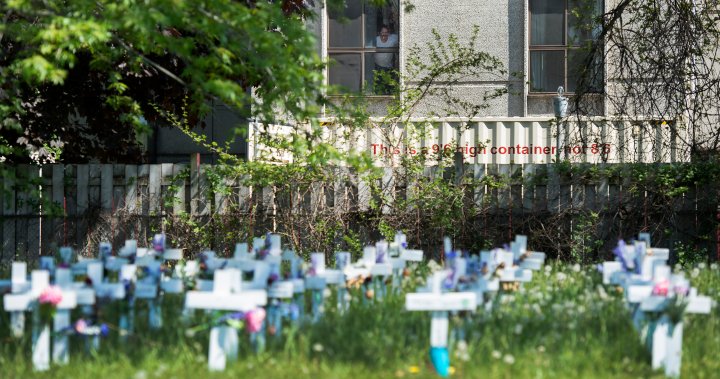


According to the latest community respiratory illness surveillance program (CRISP) report from the government of Saskatchewan, the province has detected a new COVID-19 variant after the holidays.
The report, which covered Dec. 18-31 of 2022, shows that Omicron subvariants BQ.1.1 and BQ.1 made up nearly 82 per cent of COVID-19 cases identified in Saskatchewan at the time.
There were also reports of at least two cases of the XBB.1.5 subvariant, which is spreading in other parts of Canada and the world but has not been found before in Saskatchewan.
Health authorities in the United States and the United Kingdom predict XBB.1.5 will quickly become the dominant strain of COVID-19 in their respective countries.
Story continues below advertisement
It was first detected in October and has been found in 29 countries, according to the World Health Organization.
According to the CRISP report, except for Regina, all areas of the province have less than 50 per cent of their population up-to-date on COVID-19 vaccines. Less than half of individuals aged 50 plus have had more than one booster dose (46 per cent).
The Saskatchewan Health Authority (SHA) is being forced to spend over $100,000 to dispose of 559 pallets of expired hand sanitizer, which it had no intention of donating before the expiration date.
“We or our clients probably could have made use of these,” said Stephanie Taylor, executive director of Regina Transition House. “There have been a lot of donations from the community and different organizations of hand sanitizer, but we did have to resort to purchasing some at times.”
The pallets have been collecting dust in a Regina warehouse since earlier in the pandemic.
“Our clients didn’t necessarily have consistent access (to hand sanitizer) once they left the shelter,” Taylor said.
Story continues below advertisement
The SHA said it received huge volumes of the product at a time when sanitizer was scarce.
“It was not purchased. The sanitizer you refer to was supplied to us by the Public Health Agency of Canada (PHAC) as part of a large volume of medical supplies sent to each jurisdiction in Canada throughout the pandemic and particularly at the beginning of the pandemic when hand sanitizer was extremely hard to obtain,” said SHA representative James Winkle.
Global News asked the SHA if it considered donating extra shipments to organizations in need such as emergency shelters or community centres in the area before the expiration date, to which it responded it did not.
“No, the SHA did not donate the hand sanitizer to anyone,” the SHA said in a statement.
“While the Saskatchewan Health Authority (SHA) very much appreciated the PHAC shipment, the SHA was able to source a more effective sanitizer supply in the interests of patient and public safety.”
While the SHA was using this supply for its own operations, the unused pallets of hand sanitizer were left in the warehouse to expire. The SHA now has to begin a bidding process to dispose of the hazardous substance, which will cost the organization over $100,000.
Story continues below advertisement
“What a waste of funds that could have been used for other programs,” said Amanda Benesh, development coordinator at Carmichael Outreach Inc. “I’d like to know the actual cost waste on that much sanitizer. How much of the Saskatchewan’s taxpayer’s money was wasted?
“There should always be some sort of repercussions for wasted taxpayers’ money, but unfortunately, it will probably just be a tongue wagging to whoever approved it.”
More than 50,000 Canadians have died after contracting COVID-19 since the pandemic emerged nearly three years ago, the Public Health Agency of Canada (PHAC) confirmed Monday — a sobering reminder that the virus remains a deadly concern.
The national death toll first crossed 50,000 last Tuesday, according to data compiled by Johns Hopkins University and confirmed by a Global News analysis of provincial health data.
By Monday, the toll had reached 50,135, according to PHAC, which reports national data weekly based on provincial reports that are released throughout the week.
XBB.1.5 variant cases projected to make up 7% of COVID-19 cases by mid-January in Canada: Tam
Quebec, which is the only province that still reports COVID-19 data daily, has seen the most confirmed deaths of any jurisdiction with 17,865 fatalities to date. Ontario has the second-highest provincial death toll as of Friday, which sits at 15,786, followed by Alberta at 5,470 deaths as of Wednesday.
Story continues below advertisement
British Columbia has seen 5,007 deaths according to the most recent data released on Thursday, a day that also saw Saskatchewan report a total of 1,826 deaths to date. Friday’s report saw Manitoba record 2,403 deaths since the pandemic began.
In Atlantic Canada, New Brunswick and Prince Edward Island have recorded 762 and 85 deaths, respectively, as of Tuesday. Newfoundland and Labrador upped its death toll to 297 on Wednesday. As of Thursday, Nova Scotia has seen 706 deaths.
Yukon, the Northwest Territories and Nunavut stopped reporting their data last year, and have confirmed a combined 61 deaths since early 2020, half of which were in the Yukon.
Despite the prevalence of COVID-19 vaccines, treatments and overall immunity to the virus, about 40 Canadians are still dying from COVID-19 per day on average, according to Global News’ analysis of provincial data.
Those figures reflect the number of people confirmed to have tested positive for COVID-19 who later died as a result of the disease.
Public health experts have long said the true death toll is likely far higher than the official count. Since the more transmissible Omicron variant took hold in late 2021, most COVID-19 tests are performed privately at home and not shared with public health authorities.
Story continues below advertisement
The World Health Organization said in May that, while the official worldwide death toll from COVID-19 at the time was about 6.2 million, an estimated 14.9 million deaths were “directly or indirectly” related to the pandemic.
The estimate, based on excess mortality compared to pre-pandemic years, included indirect deaths caused by impacts the pandemic had on the overall health-care systems and social services around the world.
Masks recommended on long flights amid COVID variant spread: WHO
The number of confirmed deaths around the world has since climbed to over 6.7 million, according to Johns Hopkins University and the WHO.
The WHO’s latest situation report says confirmed global COVID-19 deaths have risen about 18 per cent since the week before and are up 20 per cent from the previous 28-day period.
As of Friday, more than 4,400 Canadians are in hospital with COVID-19, including over 240 patients in intensive care, according to provincial data. Those numbers have declined over 10 per cent from just a week ago.
Story continues below advertisement
An average of about 1,800 new infections are still being confirmed per day, which is down about 15 per cent from the rate seen two months ago.
The country is currently monitoring the spread of XBB.1.5, a sub-lineage of the Omicron subvariant XBB that has been deemed by the WHO as the “most transmissible” COVID-19 variant so far.
New Omicron subvariant XBB.1.5 confirmed in Canada
The subvariant, which has earned the nickname Kraken on social media, is spreading rapidly in Asia and is believed to now account for about half of all new cases in the United States, according to the U.S. Centers for Disease Control and Prevention.
On Friday, Canada’s chief public health officer Dr. Theresa Tam said the variant’s spread has risen from 2.5 per cent of new Canadian infections at the start of this year to about seven per cent by mid-January.
Story continues below advertisement
She added it remains unknown whether XBB.1.5 will become the dominant strain in Canada as it has in the northeastern U.S., where it accounts for 70 per cent of cases.
“The absolute number of cases is not surging at this time, nor is there evidence of increased severity with this or other new variants,” she told reporters in Ottawa, citing the overall seven-day average in cases and declining hospitalizations.
PHAC has not said yet if it considers XBB.1.5. a variant of concern.
With its airport in “recovery mode” as traffic levels recover from pandemic lows, Regina Airport Authority (RAA) is raising some of the fees it charges passengers and airlines.
Beginning April 1, RAA’s “passenger facility fee” will increase from $20 to $30.
These fees are paid to the airline and remitted to RAA. They’re applied to every departing ticket for a trip initiating at the airport and travelling out-of-province. For intra-provincial flights the fee will remain at $5.
RAA leadership said the increase is directly related to fund capital investments, but added that losses incurred during the pandemic, rising interest rates and inflation are also affecting finances.
Story continues below advertisement
“Our airport is about to undertake a significant investment in our main runway through an overlay project valued at about $26.7 million,” said RAA president and CEO James Bogusz.
“This project is half funded by the federal government but the airport authority will have to raise its own half. In totality the airport’s debt will be set at around $50 million based on previous investments from past years. Now we’re in recovery mode. To afford all of this we have to increase our fee.”
The overlay project will include new paving, an updated lighting system and drainage improvements.
This is first increase to the passenger fee since 2012, Bogusz says.
RAA is also increasing its landing and general terminal fees by five per cent.
“The Regina airport is one of the lowest cost airports in the entire country for an airline to land at,” Bogusz said, adding, “the airlines have been supportive of this change”.
“During the pandemic and in the last five years we have not raised our fees a single dollar. We really needed the fee increase, but because we wanted to see airlines come back to our city, we held the line. We took the hard road. We had to reduce our staff, defer capital projects and reduce our expenses.”
Story continues below advertisement
Speaking to Global News Thursday morning, Bogusz said the strategy is paying off.
He said in December the airport saw 74 per cent of pre-pandemic passenger levels, and that airline capacity recovered to almost 92 per cent of pre-pandemic levels — the biggest rebounds yet.
Bogusz said December 2021 saw just 30 per cent pre-pandemic passenger levels.
“We outperformed almost every other Canadian city of our size and that’s because our fees have remained low but also the great work of our partner organizations in the city bringing in great events.”
Brick + Mortar, a new vendor at Regina International Airport, has a focus on locally created products.
Connor O’Donovan / Global News
Bogusz’ optimism comes despite airlines recently announcing cancellations of services out of Regina, highlighting WestJet’s recently-announced plans to increase service to Calgary.
Story continues below advertisement
“If you look at WestJet into February and March, we haven’t seen these types of low prices almost through the entire pandemic,” he said.
“Many of their flights currently are available for sale between Regina and Calgary between $200 and $250. I see some in the high $100s. This is without Air Canada competing on the same route.”
Brick + Mortar Owner Janis Procyk says it’s exciting to see airport traffic rebound.
Connor O’Donovan / Global News
Other changes at the airport include a new restaurant, Brioche Dorée, on the main floor and the opening of a new storefront, Brick + Mortar, near the departures desks.
Brick + Mortar owner Janis Procyk said the increase in traffic the airport is seeing is “a big relief”.
“Being in a place where things are starting to return to normal is a really positive and uplifting thing,” she said.
Story continues below advertisement
“It’s great to have some happier things and some return to what we used to know.”
Skyxe Saskatoon Airport, meanwhile, charges an “Airport Improvement Fee” which can only be used for capital investment. A spokesperson says the organization is not planning to raise the $23.00 fee in 2023.
“The SAA completed a significant capital program directly prior to the 2020 pandemic, including a major terminal renovation, curbside and parking re-development, check-in hall renovation, baggage handling system replacement, and repair work to our secondary runway,” added Business Development and Service Quality vice-president CJ Dushinski.
“As we begin planning for the next phase of major capital investments, including arrivals hall renovation and ground-side road infrastructure, we will continue to evaluate any potential increases needed for our AIF in the future.”
Its aviation fees, paid by airlines and other aircraft operators, will also rise by five per cent. The increase is effective March 1, 2023.
Canadian airline executives apologize for holiday travel chaos
An investigation by the Saskatchewan Information and Privacy Commissioner has found that Saskatoon Public Library breached an employee’s privacy when it asked for proof of COVID-19 vaccination or test results, even though a provincial mandate had been lifted.
Library management told employees on March 11, 2022, that they must continue to submit proof of vaccination or a negative COVID-19 test, even though the Saskatchewan cabinet lifted the Employers’ COVID-19 Emergency Regulations on Feb. 14.
“They needed to have authority to do it,” said Ronald Kruzeniski, Saskatchewan’s Information and Privacy Commissioner in a report dated Jan. 16. “At one point, the province introduced a regulation that gave them that authority, but on Feb. 14, that authority was rescinded.”
The report stated that “without the Employers’ COVID-19 Emergency Regulations, an employer can no longer demand vaccination/test and an employee is no longer required to comply with a vaccination/test demand made by an employer.”
Story continues below advertisement
Saskatoon library took it upon itself to enforce its own mandate until May 31.
A library employee confronted management and said that the request was “in violation of the Saskatchewan Employment Act and HIPA.”
Saskatoon library (SPL) responded to the employee the same day. “SPL has a policy that requires employees to submit COVID test certificates with negative results if they have not submitted proof of vaccination. SPL is no longer asking employees to submit proof, but if they have not yet done so, then they submit test results. The policy is within our legal rights.”
In a statement to Global News, the library claimed it was operating under its personal COVID-19 Exposure Control Plan, which “in addition to many activities designed to provide a safe working environment, required mandatory employee masking, testing and proof of vaccination.
Saskatoon library had provided the complainant with the “Testing and Vaccination Exposure Control COVID-19 Policy” document, which was created by the municipal library, not the provincial government.
“You are expecting me to comply to an invasion of my privacy and are refusing to answer my questions to justify the invasion,” the complainant said in response to the library’s documentation. “I fail to see why it is so difficult to provide me with the law or regulation that permits a person’s private information to be demanded by an employer.”
SPL claimed it had a duty to take every reasonable precaution to protect workers.
“SPL determined the frequency of contact with the general public in the workplace created a high-risk environment for the transmission of COVID to employees and took measures to reduce workplace hazards,” read the statement.
The Privacy Commissioner explained that while many will look at public safety and consider it more important than privacy, the library still did not have the authority to make its request.
Kruzeniski recommended the library ensure that all of the COVID-19 test results from the complainant within the system (including emails) be destroyed within 30 days.
SPL told Global News that all employee testing and vaccination status information was removed from its system in June 2022.
Coun. Darren Hill on 2023 budget, downtown arena and new library
COVID-19 has changed. If you’re vaccinated and not immunocompromised, the disease is usually not as deadly as it once was.
But it still poses risk. With statistics changing and new variants emerging, it can be confusing to figure out what exactly that risk is.
One of the reasons for this, a physician and epidemiologist told Global News, is a symptom not caused by the disease but by living in the pandemic — that it’s not how the virus has changed, but how we have.
“We’re not into a time anymore of nobody having protection and therefore needing to mandate masks and vaccines in order to prevent a complete overwhelming of our health system and massive deaths,” said Dr. Cory Neudorf, senior interim medical health officer with the Saskatchewan Health Authority.
Story continues below advertisement
“But we’re still seeing a continued (and) fairly high level of (hospital) admission and deaths that we’ve become a bit numb to.”
He said some of the confusion come from other viruses circulating, like rhinovirus (which can cause the common cold) and influenza, and the fact healthcare providers have changed how they test for COVID-19.
Whereas health authority personnel used to test everyone who visited a hospital, testing is now restricted to people who exhibit respiratory illnesses.
Two other doctors told Global News that in most cases testing doesn’t necessarily affect how they treat the patient.
“If it looks viral and behaves viral, then we can assume it’s viral,” said family physician Dr. Marlys Misfeldt, adding that she now typically treats patients with COVID the same way she treats patients with severe influenza, sometimes referring them to hospital.
She stressed that influenza and COVID are still serious ailments and said she’s had patients require intensive care and die from influenza. She said still gets anxious when an immunocompromised patient contracts COVID.
So many respiratory illnesses are circulating, Misfeldt believes, because fewer people are wearing masks.
Story continues below advertisement
And adding to the blurry image of COVID, she also said it seems like no patients have and use rapid tests anymore.
Dr. Ben Thomson, head of pediatric emergency medicine at the University of Saskatchewan and a pediatric emergency room doctor, said the focus is on viral illness, not testing.
“Most of the time, when somebody comes to the emergency, if they’re sick with a viral illness, we don’t strictly need to test them for which virus it is.”
He said the ERs are no longer swamped like they were weeks ago. Now he said they’re closer to a usual busy winter.
And while he said staff are still seeing a lot of COVID, they’re mostly treating patients for Respiratory Syncytial Virus (RSV).
The latest provincial respiratory illness report shows preschool-age children have the highest rate of RSV positivity at 14.5 per cent.
But out of all the respiratory illness the report tracks, COVID-19 caused most hospitalizations.
While test positivity and hospitalizations from COVID decreased, more people died in the past two weeks compared with the week prior.
Story continues below advertisement
If the biweekly numbers don’t help illuminate the state of the pandemic, COVID-19 Resources Canada puts out a report with a “hazard index.”
The latest report places the province’s COVID hazard level at “very high.”
The rating is based on measures like wastewater, hospital and intensive care admissions and deaths from COVID in each province.
The report’s author, infectious disease researcher Tara Moriarty, said the purpose is to provide information.
“What people really want is an idea of what it’s likely like in the current weeks so that they can make decisions about what we should or shouldn’t be doing,” she said, speaking from French River, Ont.
“We take the trends that have been happening in the previous few weeks and we forecast forward by about a week.”
She said Saskatchewan’s “very high” rating will likely increase in coming weeks, with the latest subvariant XBB.1.5. now present in the province.
Given that the World Health Organization believes XBB.1.5 appears to be the most transmissible yet, and that the report places other province’s hazard levels much higher than Saskatchewan’s (Ontario and Quebec are both “severe,” and Novia Scotia’s numeric rating is off the 10-point scale), Moriarty said she expects hospitalizations, ICU admissions and deaths again to increase.
Story continues below advertisement
But she said the impact may be blunted because so many people in Saskatchewan were infected in previous waves.
“It’s not that Saskatchewan will avoid it, it’s just that it may not be quite as intense as it is out east.”
But what does that mean for your risk level?
“There are times when you should be more personally interested in (the pandemic), but also times when we need to respond as a community to try and get the rates of infection down,” Neudorf said.
“And that’s where we are right now.”
He said the province’s hospitals are still seeing “fairly high” admissions from COVID and other ailments.
“The biggest problem has been the number of patients who are unwell enough that they need to be admitted into hospital, taking up a lot of hospital beds because of oxygen needs or heavy breathing,” Thomson said.
Neudorf and Thomson both said they expect a surge from XBB.1.5 spreading through Saskatchewan.
What helps insulate people from the risk, and changing risk, is the fact safeguards remain the same. All four health experts to whom Global News spoke said people should get vaccinated and wear masks.
Story continues below advertisement
“If you’re sick, it doesn’t matter how you’re testing, stay home,” Neudorf said.
“I’m still wearing my mask when I’m in enclosed spaces. So I still treat everybody as if they’re positive,” Misfeldt told Global News.
“Life can’t stop,” Thomson said, “but people should be prudent.”
The Saskatchewan government is not considering decriminalizing any illicit drugs at this time, but the conversation is continuing among authorities and advocates in the province as a pilot project gets underway in B.C.
Beginning Tuesday, B.C. will start a three-year trial to test the effects of drug decriminalization in the province.
The First Nations Health Authority (FNHA) in B.C. says on its website that people 18 years of age or older will be able to possess a cumulative amount of 2.5 grams of certain illicit drugs without fines, arrest or seizure.
“B.C. gets to be the guinea pig, if you like, for this pilot project with the federal government,” Saskatchewan Minister for Justice Bronwyn Eyre said in December 2022 after the plan was announced.
Story continues below advertisement
The drugs being decriminalized in B.C. are opioids, including heroin and fentanyl, cocaine, methamphetamines and MDMA (ecstasy), with the FNHA noting that these are the drugs that are poisoned in B.C.’s toxic drug supply.
B.C.’s goal is for this to reduce shame and stigma surrounding drug use so people can feel more comfortable seeking help.
“This will mean that many people are likely to be more open about their substance use, talk about it with friends, families and care providers, and feel like they do not have to hide their use – and use alone, where no one is available to provide naloxone or call for help,” FNHA’s website reads.
The government of Saskatchewan confirmed in a statement to Global News on Tuesday that it is not considering criminally exempting any drugs like methamphetamine or cocaine.
“It is unknown what potential long-term effects that decriminalizing illicit drugs will have with regards to public safety,” read the statement.
“The Government of Saskatchewan’s focus continues to be on funding programming and services to help individuals experiencing addictions issues and providing pathways to treatment.”
Saskatchewan Minister of Health Paul Merriman was asked for his reaction to the trial several times at a press conference on Tuesday. He said that decriminalization is not being considered in Saskatchewan and passed the question off to Minister of Mental Health and Addictions Everett Hindley.
Story continues below advertisement
“It’s not on our radar right now,” said Hindley. “We are focused here on treatment and recovery and the additional investments we have made towards harm reduction.
“Ultimately, we want to make sure that we are providing to people access and avenues to long-term treatment and recovery.”
B.C. confirmed that this does not mean that drugs are legalized.
“The drugs covered under this exemption remain illegal,” the province said in a release. “The selling (or trafficking) of controlled substances remains illegal under the Controlled Drugs and Substances Act, regardless of the amount.”
Saskatchewan Association of Chiefs of Police president Rick Bourassa said that while there are no plans to decriminalize drugs in the province, it has been a conversation among authorities.
“We support it as long as the appropriate resources and supports are in place to make it successful,” said Bourassa.
He explained that if a similar trial were to be considered in Saskatchewan, police and authorities would look at the consequences of addictions in the community.
“One of the metrics that we would be looking at is the harms in terms of death in our province.”
Executive director Kayla DeMong of Prairie Harm Reduction in Saskatoon said she hopes this is a move in the right direction for the country.
“It will be really interesting to see what happens on the justice side of things as far as if people will still continue to be harassed and arrested,” said DeMong.
DeMong feels strongly that decriminalization should be implemented across the country.
“Decriminalization has been shown in other countries to be incredibly beneficial and have huge impacts on the justice side of things and the social side of things.”
She said she has heard the topic being discussed locally in Saskatoon but wishes it would extend across Canada.
“We wish them all the success in the world that this is a successful program, and we will be speaking with them and learning from it as we move forward,” Bourassa said.
“It’s a conversation that needs to continue.”
Story continues below advertisement
Officials hope B.C.’s drug decriminalization plan will reduce stigma around drug use
— with files from Global News’ Brody Langager, Amy Judd and Kristen Robinson
She didn’t expect it. Her doctors told her she was palliative and for years she had less than one per cent kidney function.
She had a transplant surgery booked in September 2021 but, barely a week after securing the date, the Saskatchewan Health Authority (SHA) postponed her operation – along with thousands of other surgeries so they could reassign staff amid COVID-19 pressures on the health system.
Bailey finally received the transplant last November, nearly four years after she was first diagnosed with kidney failure.
“(I) didn’t think it was going to happen, for the struggle that I was going through,” she said. “There’s not even a word for it. It’s just like you’re basically getting your life back.”
Story continues below advertisement
A new report shows that’s happening for more and more people, with the number of organ transplant surgeries approaching 2019 levels after the COVID-19 pandemic delayed so many, by “(placing) an unprecedented burden on health care systems in Canada and around the world.”
According to the Canadian Institute for Health Information (CIHI), 2,750 solid organ transplants were performed in Canada in 2021, which is only eight per cent less than the 2019 amount.
The amount of dead and living donors is also rebounding.
“There’s certainly an impact and one that I expect to continue to have a catch-up period,” CIHI researcher Nicole De Guia said, adding that the numbers don’t capture people who need organs but who weren’t on waitlists.
The report, which gathers information from provincial health and transplant organizations, says 1,673 kidney transplants took place nationally in 2021, with 3,060 people still waiting for the procedure.
And it found that 105 people died waiting.
“Although we’re approaching the pre-pandemic (levels), it’s just clear that there’s a lot more work to do because we want to continue to increase and meet the demand,” De Guia said, speaking from Toronto.
Story continues below advertisement
CIHI’s findings also show Saskatchewan lagged behind the national figures. Where the country collectively had seven per cent fewer surgeries in 2021 compared to 2019, Saskatchewan had 45 per cent fewer surgeries.
“These are data, De Guia said, “but they’re critically ill patients and (the delay) impacts on their families and support systems as well.
“So really… we still have a long way to go.”
Global News asked the SHA how many people are waiting for kidney transplants and if the Health Authority had cleared the COVID-19 surgery backlog.
They did not answer by publication deadline.
Green Shirt Day continues to grow and bring awareness to organ and tissue donation
Jessica said she was very lucky to survive her kidney failure.
Her health deteriorated after her surgery was postponed. She was on dialysis and suffered a hematoma (a pooling of blood in her body) and caught COVID-19. She struggled to get healthy enough to receive the organ.
Saskatchewan says efforts to recruit health-care workers are working as the province has made over 160 job offers to Filipino health-care workers to date.
The efforts have come through the province’s Health Human Resources (HHR) Action Plan to recruit, train, incentivize and retain health-care professionals.
In a release, Saskatchewan Health Minister Paul Merriman said that sustained work continues under the four pillars of the province’s HHR Action Plan.
“I am pleased to see steady progress in all areas of focus,” Merriman said. “As we start a new year, I look forward to more actions to build on the successes we have had so far. It’s important we continue to spread the word that Saskatchewan is an outstanding place to build and grow your health-care career.”
Story continues below advertisement
The province stated that registered nurses (RNs) from the Philippines received conditional offers who have begun working their way through the RN Pathway, which includes language, bridging education and licensing. Saskatchewan continues to progress by creating more permanent full-time positions and attracting health professionals to high-priority positions in rural and remote areas across Saskatchewan.
According to the statement, the Saskatchewan Health Authority (SHA) has hired more than half of the new full-time and enhanced part-time to full-time permanent positions posted, with over 90 of those positions now filled.
“It’s encouraging to see our competitive Rural and Remote Recruitment Incentive financial packages are generating interest and we are making progress in attracting health-care candidates in rural and northern communities throughout Saskatchewan,” Rural and Remote Health minister Everett Hindley said.
“Our province has a lot to offer to those interested in training and working in health care, from recent graduates to experienced health professionals. These health professionals will begin a new job and build their career within these communities and will also grow strong connections and enhance their lives with the rewarding experiences Saskatchewan communities of all sizes have to offer.”
The province said that there are more opportunities available to connect nursing graduates with job offers.
Story continues below advertisement
“Of the 78 graduates from the December cohort, 68 students have submitted their expression of interest to the SHA for the Grad Nurse Expression of Interest initiative that matches graduates with an area based on skills and preferences,” according to the release. “As of January 18, 2023, 29 students have accepted conditional job offers.”
The HHR Action Plan also includes First Nations and Metis recruitment and retention initiatives. One initiative includes the Indigenous Birth Support Worker program which is a partnership between the SHA and The Gabriel Dumont Institute, that offers 12 seats for an eight-week program commencing March 2023. Recruitment and retention engagement sessions with a number of First Nations, Tribal Councils and Metis Nation-Saskatchewan were held in November, December and January.
Progress continues under each of the four pillars of Saskatchewan’s HHR Action Plan, which are recruiting, training, incentivize, and retain. The province said that its $60-million HHR Action Plan, announced in September 2022, will add more than 1,000 health professionals into the health system over the next few years.
Almost 60% of Saskatchewan nurses considered leaving profession in past year, survey shows
After giving birth to her son on April 18, 2021, 38-year-old Jennifer Ferger in Victoria, B.C., had difficulty producing breast milk.
“We were concerned about my supply,” she told Global News in an interview this week.
After consulting with her midwife, she was given a number of choices, including herbal remedies and lactation cookies, to help increase production.
Finally, she settled on starting a prescription drug called domperidone recommended by her midwife.
“I wanted to give it the best shot I could, to provide breast milk,” she said.
While domperidone has been officially approved by Health Canada for treating gastrointestinal disorders since 1985, it is also sometimes prescribed postpartum to help increase the supply of breast milk.
Story continues below advertisement
Domperidone “antagonizes” dopamine, which allows for prolactin — the body’s milk-making hormone — to rise and increase milk production, said Jessica Bawden, a nurse practitioner at the Women’s College Hospital and an international board-certified lactation consultant, in an interview with Global News earlier this week.
However, as noted by Health Canada, domperidone is not authorized for use in the country for the purpose of increasing lactation. A side-effect of domperidone is increased breast-milk production, Bawden said.
Although off-label drug use — where a drug is prescribed for something that it wasn’t intended for or approved for — is a very common practice, using domperidone to stimulate lactation should be the last resort, Bawden added.
B.C. woman talks ‘withdrawal’ symptoms after going off domperidone
People who breastfeed should only take domperidone when they have “exhausted all of the first line ways of increasing milk supply” that are known, she said.
Story continues below advertisement
Kim Smith, international board-certified lactation consultant, who’s been in the field for 12 years, told Global News that domperidone is “fairly common” in her practice.
“But we still don’t universally know who’s going to benefit and who’s not,” Smith said.
“So, it’s often a just give it a try. And if it works for you, great. And if it doesn’t, then you know, then it doesn’t. And so, I have seen very mixed results.”
Studies published in the Canadian Medical Association Journal suggest the use of this drug to boost breastfeeding increased from the early 2000s through 2017.
For Ferger, she was assured by her midwife that the drug was commonly used and that she had prescribed it “many times before.”
Story continues below advertisement
“I was told it was completely safe and normal,” she said.
Though a maximum dose of 30 mg of domperidone per day is recommended by Health Canada — for gastrointestinal issues — Ferger’s dose was tripled, as her midwife prescribed her 90 mg per day.
Her breast milk supply tripled during the three months that she was on the drug but “it was a very difficult time,” she recalled.
By month three, Ferger started to have digestion issues and her mental health started to suffer as well. She decided it was time to switch to formula feeding and get off the drug.
“I didn’t feel good, I didn’t feel good, mentally. It just made things worse and made me feel gross. I was not doing well,” she said.
New study found breastfeeding babies can offset risk of asthma from antibiotics
When Ferger finally made the choice to take herself off the drug, her symptoms got worse.
Story continues below advertisement
“It was awful, and I was already in a fragile state,” she said of the side effects she began to experience after she stopped using domperidone.
“The withdrawal was the worst part,” Ferger said.
At first, it started with insomnia. Then, came constant “blushing” in her stomach.
“That feeling when you go on stage or are public speaking and you get that drop in your stomach — that blushing of your stomach,” Ferger explained.
“It wasn’t just a wave. It was constant butterflies in my stomach.”
And then, the intrusive thoughts came.
“I remember saying to my husband: ‘I’m having bad thoughts. I don’t want to be here anymore,’” Ferger said.
“I want to crawl into a cave and die,” she told him.
Eventually, Ferger was able to properly wean off the drug with help from her midwife.
Jennifer Ferger with her husband, stepson and son born in April 2021.
Provided by Jennifer Ferger
Thirty-six-year-old Jessica C., an employment specialist based in Ontario, told Global News that the side effects of domperidone “robbed” her of the joys of being a mother.
Story continues below advertisement
She was prescribed the drug five months post-partum and was told not to look it up online it by her health care provider.
“Within a couple days (of the medication) I started to have feelings of intense rage that actually scared me. And I would get really angry out of nowhere. And that’s not me at all,” she said.
Now, Jessica, who is still on domperidone, “regrets” taking the drug.
“I think it’s robbing me of the joy of being a mother,” she said. “I should be able to be happy and enjoy my time… (but) I’m stressing constantly about my own mental health.”
Recently, Health Canada called for the safety review of using domperidone off-label for increasing breast milk supply in postpartum people, based on “domestic and foreign case reports of withdrawal symptoms after stopping or reducing the dose of domperidone used to stimulate lactation.”
Story continues below advertisement
Across the border in the United States, the Food and Drug Administration (FDA) has banned domperidone altogether — even for its intended use to treat gastrointestinal symptoms — over cardiac risk concerns.
On its website, Health Canada also warns about domperidone’s association with potential cardiac risks, including sudden cardiac death. The agency already has two separate safety alerts both on domperidone and the risk of “serious abnormal heart rhythms and sudden death (cardiac arrest)” issued in 2012 and 2015.
But experts are worried that such safety warnings would cause people to panic and immediately stop using it — and that may not be the solution.
Alixandra Bacon, president of the Canadian Association of Midwives, said people should consult with their health-care provider and emphasized the importance of tapering off this medication if they have any concerns.
“I’m afraid that these news reports might have the unanticipated impact of increasing side effects if people panic and stop (using),” Bacon said.
Bacon also pointed out the lack of support birthing people have during and after pregnancy in Canada, brought to light by the issues around domperidone.
“In Canada, unfortunately, we have a lack of lactation support, and we have a lack of perinatal mental health support,” she said. “That’s why it’s critical that every birthing person has access to a midwife and or a lactation consultant.”
Story continues below advertisement
Smith agreed.
“You need more breastfeeding support in general,” she said.
“I think you really should reach out for support because there are so many things that we could examine and look at to try and make things better.”
What is the policy across provinces?
In B.C., prescribing domperidone is within a nurse practitioner or midwife’s scope of practice. It is not within a registered nurse’s scope to prescribe domperidone, the BC College of Nurses and Midwives said in a statement to Global News.
“Prescribers must meet their standards, which includes being responsible and accountable to their prescribing decisions and using current evidence to support their decision making,” the statement said.
Marie Tarrant, professor at the University of British Columbia’s school of nursing, told Global News it’s “not uncommon” for domperidone to be prescribed to individuals postpartum who are having difficulties breastfeeding.
Story continues below advertisement
“I think it’s more common probably than we think because it is an off-label prescription,” she said, noting the drug is often prescribed in circumstances where a baby is born preterm.
“I think we really need to do a proper safety review and a proper evaluation of the benefits and risks so that people can make informed decisions,” Tarrant said.
In Ontario, too, midwives have the authority to prescribe and administer domperidone “for the purpose of promoting lactation,” said Kelly Dobbin, CEO and registrar of the College of Midwives of Ontario, in an interview with Global News.
Support for breastfeeding mothers
In Saskatchewan, while midwives are not authorized to prescribe the drug to increase breast milk supply, they are allowed to give it to patients as an antiemetic — to help prevent vomiting, according to Cheryl Deschene, executive director and registrar at the Saskatchewan College of Midwives.
Story continues below advertisement
In Quebec, Julie Pelletier, president of Ordre des Sages-Femmes du Quebec, told Global News that midwives do prescribe domperidone to people who have “significant breastfeeding challenges.”
“It’s not rare, but it’s not uncommon either,” she said, noting patients are provided with the proper information about the drug.
“We continue to inform the client and give them the whole picture and continue to support women’s choices,” Pelletier said.
“Breastfeeding is important, mental health is important, but they don’t have to be mutually exclusive.”