A confidential memo was shared by the Sask. NDP from the Saskatchewan Health Authority telling staff members not to talk to political parties or MLAs about hospitals.
“The Sask. Party government is running our hospitals into the ground and muzzling the nurses and doctors trying to speak up,” said Opposition health critic Vicki Mowat.
“We’re in a national competition to hire and retain healthcare workers. This government should be listening to healthcare workers, not silencing and censoring them.”
Staff members from Lanigan Integrated Hospital were told to direct any questions aimed at them to central co-ordination.
The memo was issued when NDP MLAs visited Lanigan as part of their outreach tour on Feb. 7.
Story continues below advertisement
A leaked memo from the SHA telling staff to direct questions about a hospital to central co-ordination.
Saskatchewan NDP
“This muzzling-memo raises serious questions about the Sask. Party’s credibility when it comes to healthcare,” said ethics and democracy critic Meara Conway.
“The Sask. Party’s decision to centralize health regions has not improved our hospitals or made waits shorter. If anything, we’ve seen repeated attempts by this current government to politicize healthcare decision-making and silence healthcare workers from speaking out.”
Health Minister Paul Merriman addressed the memo, saying he learned about it when the media did.
“There was a memo generalized to all SHA staff, part of their normal routine communications from SHA head office.”
He said there’s an individual within the SHA who co-ordinates tours to minimize disruption.
Merriman said he and his colleagues have to go through the same process if they want to tour through SHA facilities as well.
Saskatchewan’s top doctor sat down with Global News to talk about the emails he had sent to the province’s Health Minister Paul Merriman in early September 2022 warning him to put in COVID-19 restrictions, or else acute care would collapse.
Dr. Saqib Shahab said they were learning how the Delta variant differed from other versions of the virus by watching what was happening in other provinces and the United States.
“The priority was to increase vaccination rates,” Shahab said.
He said vaccination rates had stalled around 70 per cent over the summer.
Shahab said the situation was very different from 2020, adding that public health orders were much stricter at the beginning.
Story continues below advertisement
When asked if he felt like the health minister was listening to him, Shahab said there was regular communication.
“There was always regular communication from myself and my team within the Ministry of Health, and then the executive council and the minister’s office, so that is ongoing,” Shahab said.
“I think in hindsight you can look at things, and the response, but in real time I think we had to process a lot of information and provide our best case assessment, and what we thought would be an appropriate response.”
He said the most frustrating thing for him was when the province had a lot of vaccines for people, but the uptake was low.
Shahab comments on COVID-19 warnings to provincial government
“We were seeing Delta waves in other parts of the world where they hadn’t even received enough vaccines to start vaccinating middle-aged adults, and they were seeing great pressures there.”
Story continues below advertisement
He said the vaccination rate did go up a bit, but the remainder left the population vulnerable.
“The fully vaccinated were well protected. People who were unvaccinated, many came forward, and many still did not come forward.”
He said there was so much misinformation out there, which he said was difficult to deal with.
It has been a tiring road for one Lashburn, Sask., family as they have been left waiting for an MRI in the province.
“It’s very frustrating and it makes me feel like our health system is failing,” said Pat Blair, as she sat with her husband Doug reflecting on their journey.
Pat was supposed to receive an MRI in March, after injuring her knee in February, but she said due to claustrophobia, she needed sedation.
Her doctor referred her to the Royal University Hospital and told her to be there two hours ahead of their appointment. But after waiting for the doctor, bad news arrived.
“We were told that we couldn’t have the MRI because I could not be sedated there,” Pat said. “We were told that they do not do the adult sedation.”
Story continues below advertisement
And thus, they made the trip back home from Saskatoon, more than two hours’ drive from Lashburn — trip they say thankfully they can afford, but fear others may not.
“There’s a lot of people that cannot afford a trip like that and there’s no compensation for that,” Doug said. “There’s no accountability for these kinds of mistakes. It’s like they don’t care.”
Doug said it took weeks for him to get in touch with staff to figure out a solution. It was only when he contacted his MLA that he got answers from the hospital, saying they received the wrong letter.
“There were so many steps missed,” Doug said. “So many things weren’t done that were supposed to be done. All of this could have been caught if the proper paperwork was sent.”
In a statement from the Saskatchewan Health Authority (SHA), they said they are aware of Pat’s concerns and have been working with the family to address them.
“Even though standardized processes are followed, cases do occur that require follow up with the patient and family members to improve the care experience,” the SHA said.
“Medical imaging booking offices have standard practices for booking appointments. The SHA works closely with staff and clinicians to provide diagnostic services as soon as possible and as close to home as can be arranged.”
Story continues below advertisement
Meanwhile, Pat is still waiting for an MRI — a delay she said could leave her with life-altering challenges.
“My knee is going to seize if I don’t get this done,” Pat said. “And if that happens, I could be into some serious issues.”
Pat has now been told to meet with an anesthesiologist prior to rescheduling her MRI, which means she will need to make an extra trip to Saskatoon.
Pat and Doug hope sharing their story prevents these incidents from happening again.
‘Muzzling the nurses and doctors’: Sask. NDP calls out SHA staff memo
Saskatoon Mayor Charlie Clark shared his state of the city address Tuesday afternoon, highlighting the city’s plans to address homelessness, mental health and addictions.
“We see the crisis of homelessness, addictions, and mental health and intergenerational trauma escalating,” Clark said at TCU Place Tuesday. “This challenge will be critical to get right if we are going to be a city that meets our potential.”
Clark noted that city authorities are seeing double the amount of homeless people on Saskatoon streets compared to this time last year.
“First, we need to reduce the number of people getting evicted and reduce the barriers of getting rehoused,” Clark said.
He said that the re-implementation of the Saskatchewan Income Support program is the first step the city wants to take to end homelessness.
Story continues below advertisement
“Second, there is nowhere to take people with complex needs,” Clark said, calling on the province for an additional 100 beds for people in the city with complex needs. “And third, there is a complete lack of coordination in funding between federal and provincial dollars.”
Saskatoon Fire Department dealing with homelessness in the city
Clark said this creates disjoints in the funding of programs with no ability to measure outcomes or focus on addressing the largest gaps, allowing people to fall through.
The Saskatoon Tribal Council’s Emergency Wellness Centre is operating at full capacity at its new location in the Fairhaven neighbourhood, but Clark said it isn’t enough.
“We’ve seen an escalation in people who are most gripped with addictions and mental health that is putting tremendous pressure on the tribal council, on organizations that are trying to provide support for these folks.”
Story continues below advertisement
Clark said that during discussions with tribal chief Mark Arcand, he has realized that there are safety issues affecting service providers and a need to increase capacity.
People with more complex needs are sometimes not allowed at the Wellness Centre if it is already full of families.
“There is a complete lack of places to take those individuals,” Clarke said, explaining that this is why Fairhaven residents have seen more of Saskatoon’s homeless population congregating within the neighbourhood.
Wellness conference for Saskatchewan’s Indigenous community a milestone, James Smith First Nation chief says
The city is exploring options of having smaller facilities spread around Saskatoon but doesn’t know where they would be located.
“There is no place in the city that people seem at this point to welcome and say I want to have these facilities around where I am,” said Clark, adding that wherever the facilities are built, there will be concerns from the community.
“The challenge is the way that funding works for shelters is they can become more sustainable is if they have a higher number of people for economies of scale,” said Clark. “It helps with a funding program, but it doesn’t help with the impacts and to create the best environment to get people stabilized and into housing.”
Despite the challenge that the city is facing with regard to the homeless population, the mayor said the city has come a long way in the last decade, creating new neighbourhoods and amenities.
“When you add rare earths, the Canadian Centre for Pandemic Research, and the importance of the crops that we are producing here and the opportunities that we have to partner with Indigenous communities to create a whole new era for the city and the province. It’s remarkable to be here at this time.”
The mayor also touched on the progress the new downtown district and entertainment centre is making and how it will bring more growth to the city of Saskatoon.
“The discussion we are having with the public right now is to really understand what people think is key to the district to help make sure it is a place that attracts everyone,” Clark said.
Downtown Arena Land Acquisitions
He noted that it was imperative that the planning on this centre happen now, and not 10 years into the future.
Story continues below advertisement
“If we do nothing, then we will be putting the future city at risk economically,” said Clark. He suggested the possibility of having to replace the SaskTel Centre in the future without the proper funding.
“We have to recognize that whatever we do will have consequences.”
Clark still insisted that the centre won’t impact property taxes for Saskatoon residents.
Ahtahkakoop Cree Developments and the Government of Saskatchewan have reached an agreement to construct a new urgent care centre in Saskatoon.
The centre will offer 24-hour assistance to residents with non-life-threatening conditions as well as offer mental health and addiction support. The Pleasant Hill Community School currently at the location will be demolished.
During an announcement Friday, Minister of Health Paul Merriman said the new urgent care centre will provide an alternative for residents needing immediate care and is expected to ease pressures on hospital emergency departments.
The centre will be constructed and run by the Ahtahkakoop Cree Nation. It will offer 24-hour care for non-life-threatening illnesses and injuries as well as offer mental health and addiction support. It will be staffed by medical professionals and will be overseen by the Saskatchewan Health Authority.
Story continues below advertisement
The chosen location is close to St. Paul’s hospital and currently features the Pleasant Hill Community School. Colleen MacPherson, chair of Saskatoon Public Schools, said the school will close at the end of this school year. Students will be transferred to King George School in the fall. The current 95-year-old school building will be demolished by Saskbuilds.
“The school will be knocked down, but there will be pieces incorporated in the facility. We are not going to use the physical bones of this school,” Minister Merriman said.
After the school, built in 1928, is knocked down, Saskbuilds will transfer the land over to Ahtahkakoop Cree Developments in July. The land will then be designated as a reserve and will become Treaty 6 Ahtahkakoop territory.
Raymond Ahenakew, Chief of Ahtahkakoop Cree Nation, called it a historic development.
“We have an agreement between the province, the city and the First Nation, that this will be treaty six Ahtahkakoop land,” the Chief said.
Doctors will be able to get a base rate for a standard range of services for each patient, but will also get additional fee-for-service payments for extra services outside that standard range.
Saskatchewan health minister responds to retention rates among doctors, nurses serving rural communities
The province said it heard concerns about the traditional fee-for-service model from the Saskatchewan Medical Association.
Story continues below advertisement
It said this new model will also support recruitment and retention of doctors in family medicine.
“We are excited to be pursuing a compensation model that supports family physician-led team-based care and a more sustainable health care system in Saskatchewan,” Health Minister Paul Merriman said.
“We take the concerns and needs of our patients and family physicians very seriously and look forward to seeing this work advance.”
“This is very positive news for patients and physicians,” SMA President Dr. John Gjevre said.
“Family physicians are reassured to know that the government has heard their concerns and is moving forward with solutions that demonstrate they are a willing partner in addressing the challenges in our health care system.”
The government of Saskatchewan said the new payment model will take time to design through group efforts between the Saskatchewan Medical Association, Saskatchewan Health Authority and the Ministry of Health.
Sask. healthcare system ‘dissolving’
Ministers Everett Hindley and Merriman answered questions in Saskatoon on Friday from physicians.
Story continues below advertisement
Merriman said they want to move to the transition to blended capitation very quickly, adding they have the aim of having something in front of physicians within 12 months.
He said that outsourcing is only a temporary solution in Saskatchewan, adding that they don’t want to cause burnout right now.
“Outsourcing is not a long-term solution; it is a temporary solution that we need to do right now.”
“Minister Everett Hindley and I are trying to balance out on our surgical side of things how we can maximize all of the surgeons out there and our backlog without burning everybody out.”
Merriman claimed Saskatchewan was about six months ahead of other provinces in terms of recruitment for doctors and nurses.
Speakers gave examples of the lineups, wait times, staffing and retention issues seen in hospitals across the province, with one person describing it as a “train wreck.”
Dr. Carla Holinaty, a family physician and member of the SMA board, said she’s thrilled to hear that the government announced this move to blended capitation, but stressed that the association would like to see something sooner.
“We know there’s a lot of stress on our family doctors. We know there are a lot of people making decisions about their practices and whether they are staying in family medicine or moving on to other things,” Holinaty said.
Story continues below advertisement
She said the ultimate goal is to move toward a physician-led, team-based model that involves bringing in other health-care specialists to administer care.
Holinaty added she’d like to see interim funding come from the province that would be near blended capitation while doctors wait for the new model to be discussed and rolled out.
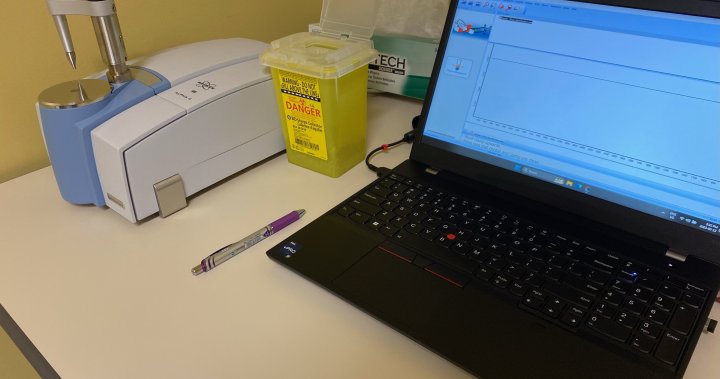
The friendship centre’s harm reduction manager said they’ve acquired a Fourier transform infrared (FTIR) machine from the Saskatchewan Health Authority (SHA) and have received proper training in Vancouver on using it.
“We have a safe injection site here as well, and we do a lot of drugs and narcotics coming through the centre,” said Emile Gariepy.
Recently, they tested a down substance and the results came back 50-55 per cent caffeine, 20-25 per cent xylitol, 10-15 xylazine and 10-15 fentanyl. Xylazine is a dangerous animal tranquillizer that is used to “buff” opioids like fentanyl.
Story continues below advertisement
“With this last finding that we found, we found some fentanyl that was contaminated with xylazine, which is something that’s been slowly spreading its way down into Saskatchewan,” he said.
“We just recently had news that it was in Moose Jaw and we were kind of waiting for it to end up here. The fentanyl sample that I did test did come back positive for it…. Ifit’s in the wrong hands, it can kill people. And I think there has been a spike in deaths lately.”
The Regina Police Service (RPS) inspector who is in charge of gangs, drugs, firearms and property crimes said fentanyl and the opioid crisis is a big issue in the community.
“Illicit drugs are often mixed with unknown additives that we don’t know,” said RPS officer Cory Lindskog. “That’s the biggest risk with injecting any kind of illicit substances. You don’t know what exactly it is that you’re ingesting.”
The work that Newo Yotina Friendship Centre has been doing regarding testing street drugs is a step toward harm reduction.
“I think anything that would keep people safe and keep them alive … could potentially have an impact on our overdoses is a positive thing,” said Lindskog.
Story continues below advertisement
According to the Board of Police Commissioners report, there were 187 occurrences in March 2023. There have been 13 apparent deaths and police attended 33 incidents and have used Narcan four times.
Gariepy encourages residents to test their drugs before using to help prevent overdoses. He said people are welcome to get their drugs tested and have the option to remain anonymous.
“Everybody’s welcome to come down here to the judgment-free zone,” he said. “They’re welcome to drop off a sample at the front desk and then we can email or text or whatever. They can come pick up their results as well after they’re after we’re done doing it.”
The Newo Yotina Friendship Centre is working with the Saskatchewan Health Authority on creating drug alerts for the community of Regina.
Regina sees over 100 overdoses a month, says Board of Police Commissioners report
Premier Scott Moe reiterated his disappointment in the federal government’s offer for additional health care funding, but made it clear that any increase in funding was needed.
“It is a two per cent lift,” Moe said. “It’s all needed, and we do need to look at how we are delivering health care, and are there better ways in delivering that health care.”
Moe said he didn’t see anything alarming in terms of the federal government’s priorities regarding health care, saying they aligned with Saskatchewan’s priorities.
He noted that there are many things up in the air in terms of the health care budget, but said the new funding will hopefully be ready by budget deliberations.
Story continues below advertisement
Moe said something he’d like to see and has been trying to navigate through is training local residents to work in the health care system.
“We’ve been increasing those training seats.”
He said the number one thing they’re trying to address is the number of qualified people working in the field, with the second priority aiming to address surgical wait times.
“Those surgical wait times that we now have are going to take some outside of the box thinking on how we’re going to approach them.”
He said they are looking at publicly-funded surgeries in the private delivery realm, noting there’s a conversation to be had for certain surgeries.
Moe said virtual health care is another tool that is becoming more commonplace.
He added health care is changing, noting programs are different now than they were five years ago.
NDP health critics Vicki Mowat and Matt Love said a different focus is needed, and that Community Health Advisory Networks need to be re-established.
“Local leaders feel shut out of health care decision making,” Mowat said.
Community Health Advisory Networks existed before local health authorities in the province were amalgamated, but were disbanded.
“It’s pretty clear that centralizing health care decisions out of the premier’s office is failing to deliver reliable, quality care for communities across Saskatchewan.”
Mowat said that’s been a reoccurring message they’ve been receiving as they tour across Saskatchewan speaking to frontline workers and local leaders.
“Local people and community leaders know what their communities need – it’s time to bring those voices back to the table.”
Love said Community Health Advisory Networks would address the needs of local health care with physician-based solutions.
“Decision making must have a local perspective at the table,” Love said.
He said if we don’t listen to local health care workers, the province will continue to see health care workers leaving the province.
Dr. John Dornan, the former CEO of Horizon Health Network in New Brunswick, has been awarded more than $2 million in compensation, plus pension contributions and benefits, after he was fired just a few months into his five-year mandate.
According to Dornan’s lawyers, this is the largest employment compensation award in New Brunswick’s history. It also includes $200,000 in aggravated damages.
Premier Blaine Higgs announced Dornan’s firing in July 2022, following the death of a patient in an emergency department waiting room in Fredericton.
Higgs also shuffled out the health minister and wiped the boards of both Horizon and Vitalité health networks.
In a release, Dornan said he was a “political scapegoat.”
Story continues below advertisement
“Nobody should have their career and livelihood taken away like that,” he said.
“I’ve had a cloud hanging over my head. I hope this decision goes some way towards restoring my reputation and allowing me to resume my career.”
Kelly VanBuskirk, Dornan’s lawyer in New Brunswick, said the doctor had spent more than 30 years building his reputation as a physician and health-care executive.
“For a person like Dr. Dornan, who has spent his entire life, really, in the health-care sector, serving people, working with the public, trying to advance the wellbeing of New Brunswickers … having his job taken from him in the way that it was, that’s traumatic, that’s upsetting, that’s humiliating,” he said.
VanBuskirk said Dornan was treated in “bad faith,” as he was “unceremoniously fired in the parking lot” shortly before the July 15 press conference announcing the health-care shakeups.
“Employers have a duty of good faith and fair dealing when terminating someone’s employment,” he said.
New pilot project announced after patient dies in waiting area of Fredericton hospital
Dornan was named CEO of Horizon Health Network in March 2022. He had been serving as interim CEO since August 2021, replacing Karen McGrath after her retirement.
Story continues below advertisement
During the news conference where Donan’s dismissal was announced, Higgs placed the blame for the struggling health-care system on management.
“It’s not up to me to run the health-care authorities but it is up to me to ensure that the right people are in the position to do so, and it starts at the top,” he said.
“If we don’t get better management results in our hospitals, we won’t get better health care.”
Howard Levitt, a Toronto-based lawyer, said Dornan was publicly blamed for many of the current problems in the province’s health-care system, including the recent death of a patient.
“There is no other way to say it — the premier threw John Dornan under the bus in a public, disingenuous and callous manner, just minutes after he fired him,” he said.
‘Tough discussions’ needed: premier
Speaking with reporters Thursday afternoon, the premier said when he made the decision back in July, he was looking to “bring a sense of urgency into the health-care system.”
“If I had to go back in July, I would be doing the same thing,” Higgs said.
Story continues below advertisement
Asked about the manner in which Dornan was fired – specifically, the “callous and disingenuous” way he was dismissed – Higgs clarified that he wasn’t talking about “what the adjudicator said and what was right or wrong.”
“I was referring to the overall situation and the changes that were made,” he said.
“I think that the statements made and the decision made are still to be evaluated, and that I’ll wait for our legal folks to give me a determination on that.”
Higgs – who is also being sued by another doctor who accused him of publicly blaming him for a COVID-19 outbreak – did not directly answer a question about what these legal actions mean for doctor recruitment in the province, but said improving services for New Brunswickers sometimes comes with “tough discussions.”
“Let’s put aside the personalities and the personal conflicts and say, ‘How do we deliver better results?’” he said.
“I just stick with that principle and so it does involve, sometimes, some tough discussions.”
‘Disingenuous and callous’ firing
In a written decision dated Feb. 15, adjudicator George Filliter accepted that Dornan was fired in a “public, disingenuous and callous manner.”
Story continues below advertisement
It said that Dornan had been asked a day before his dismissal to attend a news conference, but was not told what it would be about.
While Dornan was on the way to the news conference on July 15, it said he received a call from Higgs informing him that Bruce Fitch would be appointed as the new health minister.
It said Fitch then took the phone and “promptly terminated the grievor.”
Filliter wrote that after Dornan was terminated, the premier and the new minister of health held a news conference that referred to the recent emergency room death, and appointed a new health minister, abolished two hospital boards and dismissed Dornan as a result.
“It would be reasonable for a member of the public to conclude that the premier had concluded the grievor was responsible for this unfortunate death,” the decision read.
“Furthermore, the only conclusion to be reached from this news conference was that the announced termination of the grievor was directly related to the unfortunate death.
“In my view, these comments were made without proof and caused unjustified harm to the professional reputation of the grievor.”
Story continues below advertisement
New Brunswick premier’s state of the province address gets mixed reviews
During the adjudication hearing, which took place in December, Dornan testified that an investigation into the emergency room death concluded it had nothing to do with his management.
As well, according to Dornan’s testimony, he has been unable to find work after he was fired.
“According to the evidence of the grievor, there are no positions available in the province, even for someone of his stature and qualifications, because of the system. The two positions he previously held are no longer available,” the decision said.
The decision said he had applied out of the province and had “two very positive interviews” for a position in Saskatchewan similar to the one he was terminated from.
“But he was told by the agency hired to conduct this search on behalf of the province of Saskatchewan that when representatives of the province of New Brunswick were contacted, they did not provide a good reference,” the decision said.
Story continues below advertisement
It also said Dornan “became very much aware of the potentially precarious nature of his job” while he was still working as the interim CEO.
He testified that at one point, he was encouraged to consider ending the obstetric and gynecological services at the Upper River Valley Hospital, which he did.
“The next day he was told by the Board of the employer to reverse his announcement and later he received a call from the Premier in which the grievor was told during this conversation that he had been ‘thrown under the bus,’” it said.
New Brunswick to have nearly $250M more in health-care budget from federal funding
Filliter’s decision also noted that Dornan had signed a contract that included a termination clause, which would have entitled him to a year’s pay in lieu of notice.
However, the adjudicator found the clause was unenforceable because Dornan had only signed the contract after he had already been in his role for two weeks, and had previously orally accepted terms of his employment, which did not include details about the clause.
Story continues below advertisement
“I have no hesitation in concluding that … (he) felt he was in a vulnerable position as he had no other option having arranged to have his previous positions filled on a permanent basis,” the decision said.
“In considering the extent of his vulnerability, one cannot forget that he testified, that had this clause been mentioned in earlier negotiations he would not have accepted the offer of employment.”
In the end, Dornan was awarded special damages representing the value of lost salary and benefits for the remainder of his five-year term, as well as aggravated damages in the amount of $200,000 “for the breach of the employer’s implied obligation to act in good faith when dismissing him.”
With efforts to raise awareness and increase knowledge, the Saskatchewan Prevention Institute launched a new campaign about the dramatic rise of syphilis in the province.
According to a release, the initiative corresponds with an associated rise in cases of congenital syphilis with a primary focus on keeping children healthy. The sexually transmitted disease (STD) can be passed to babies during pregnancy or delivery.
The Prevention Institute’s Sexual and Reproductive Health program coordinator said with the re-emergence of congenital syphilis, they are seeing an increase in disability and even death.
“Syphilis is preventable. Congenital syphilis is preventable,” stated Jasmin Ogren. “We need to get the message out that syphilis is back, and that all it takes is a quick blood test and simple antibiotics to cure the infection.”
Story continues below advertisement
According to Saskatchewan Prevention Institute, syphilis infections in Saskatchewan have increased substantially since 2016 and the Saskatchewan’s Ministry of Health reported 1,940 cases in 2021, up from 924 in 2020.
The awareness campaign aims to increase knowledge about syphilis to encourage people to get tested and to know that it can be treated with antibiotics, according to the Saskatchewan Health Authority.
The Prevention Institute’s campaign includes province-wide messaging shared through online and traditional media including billboards, radio, bathroom advertising and more.
“People need to know that syphilis is here, and anyone having unprotected sex is at risk for syphilis,” stated Ogren. “But they also need to know how easy it is to get tested, treated, and ultimately, cured. Doing so will help to stop the spread of syphilis and protect babies.”
Without treatment, syphilis runs in four stages: primary, secondary stage, latent and late stages, according to the Ministry of Health website. To learn more about syphilis and to find community resources, visit talksyphilis.ca.