Saskatchewan Health Authority (SHA) is reporting that one employee has been terminated following an investigation into irregular activity in the trust accounts of several residents at the Northland Pioneers Lodge in Meadow Lake.
According to a statement, there were irregular payments for cash and purchased items from the resident’s trust account.
SHA said they referred the matter to the RCMP and charges were laid.
The former employee entered a guilty plea and was ordered by the court to pay $13,374 in restitution.
The restitution payment was received on Oct. 17, 2022. The Saskatchewan Health Authority reimbursed the residents for the remaining $2,262 that was not covered by restitution.
Story continues below advertisement
According to the statement new processes have been implemented at the location regarding purchases made on behalf of residents.
SHA says training sessions have been completed for staff in the SHA’s former Prairie North region who are responsible for handling resident accounts and cash. They say reviews are now being conducted on an ongoing basis.
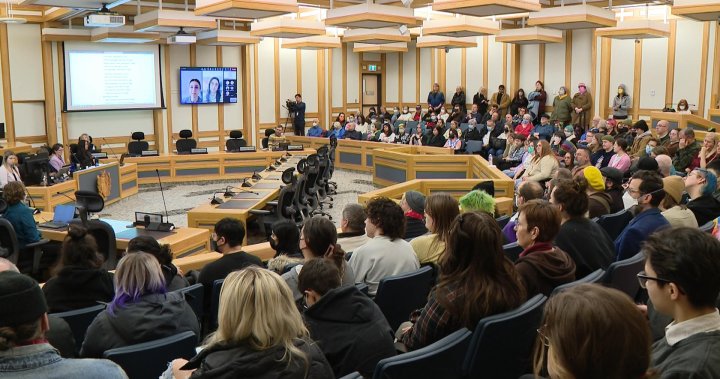
Saskatoon’s city council chambers were filled to the brim Wednesday morning as people came to speak on the topic of public changeroom access.
“I do not need a cis man speaking for me, on behalf of me, or over me, especially on International Women’s Day,” said Sarah Smokeyday, who was one of many speakers in opposition to a select few calls to restrict trans people from women’s changerooms.
There has been intolerance and an outcry online after unconfirmed reports of a person with male anatomy in the female changeroom at the Shaw Centre.
Over 300 pages of comments were submitted to the city, a vast majority of which showed support for the trans community and their right to access washrooms or changerooms that align with their gender identity.
Story continues below advertisement
Smokeyday said it was disturbing to hear people stereotype and spread misinformation about trans people.
“Statistics from first-hand accounts, police records, and court documents continually have proven time and time again that the danger to women and children is not trans women, or trans men, or non-binary folks. It’s not drag artists, or people pretending to be any of the above.”
She added she was one such survivor.
“I am a survivor of childhood sexual abuse and adult sexual violence.”
“This boogeyman scare tactic, someone hiding in an alley or changeroom, has been used regularly throughout the years,” Smokeyday said.
She said women and children won’t find danger in a change room or washroom, but instead in those who are spreading misinformation to try and control and promote fear.
“In this community, I believe it is our duty to ensure that everyone is treated with dignity and respect, regardless of their gender identity or gender expression,” said Kyle Anderson, another speaker.
“Transgender people are victims of a society hostile to their very existence.”
Story continues below advertisement
Anderson said there’s a severe lack of supports for the trans community, noting they are far more likely to suffer from substance abuse, mental health issues, and more likely to attempt suicide.
Anderson added that this is due to a society that looks at trans people as less than human.
He said the challenges trans people face are especially pronounced when trying to access washrooms or change rooms.
“Many will face harassment and violence when attempting to use facilities aligned with their gender identity. This is unacceptable, and it’s our responsibility as a community to ensure that everybody feels safe and welcome in our public spaces.”
“We’re here today because of an unsubstantiated claim, rooted in hate, designed to deprive citizens of their rights. Saskatoon is not unique in this respect,” Anderson added.
He said similar fabricated incidents were found in places like Calgary and Nanaimo as well.
“It’s clear to anyone paying attention that hateful rhetoric is being amplified, and an increase in hate crimes is the inevitable consequence.”
He said action and allyship are needed more than ever.
‘Misinformation, fear, lack of critical education’: A look at trans hate in Saskatchewan
Anderson called on the city to create a safe zone at public pools and libraries that would prevent hateful protests from being within 100 metres of those facilities.
Story continues below advertisement
“Protest is a legal right, harassment and intimidation are not.”
Among those who spoke was a 10-year-old trans-non-binary child who questioned the fear being discussed in the meeting.
“At what point do I go from being someone you protect, to someone who is a threat?” Zipp Neufeld said.
“I deserve to age without fear that the bathroom and change space that allows me to feel safe and at peace will be taken from me.”
Zipp ended by noting that when trans adults thrive, trans kids survive.
“Gender inclusivity, and inclusivity in general, has been historically proven to be safe, much more so than segregation,” Jared Young said.
Young noted that we shouldn’t be entertaining the discussion around access to public washrooms and changerooms for trans people, adding that pushback on inclusive policies is nothing new.
“They always promote the idea that women and children need safeguarding from unfounded threats. We saw this with Black people under segregation with the narrative that they’d assault and rape women if we didn’t keep facilities segregated.”
Story continues below advertisement
“We saw this in the prolonged fights to provide access to those with disabilities. We saw this with gay people under a predator-based narrative stronger than ever before. This time they warned of ‘diseased gays’ lurking in bathrooms waiting to pounce on any victim, including children.”
Young said concerns about safety are valid, but warned that extremists are co-opting that concern.
“We need to ensure that as a community we have each other’s safety in mind and are aware of each other’s needs. We need to be ready to protect everyone, especially our most vulnerable.”
Blake Tait, who also spoke at city council, stressed that the current inclusive policy in place is a deterrent to violent crime in public washrooms and change rooms.
“Trans people in Saskatoon deserve the right to access facilities owned and operated by the city. The Saskatchewan and Canadian Human Rights Commission dictate clearly that trans rights are human rights.”
“Transgender people are not criminals and are statistically proven to be a lesser threat than the general population,” Tait added.
Alexander Edmunds said the protests seen outside the Shaw Centre were transphobic.
Story continues below advertisement
Edmunds brought up the harassment and threats towards Coun. David Kirton, noting that this was unacceptable.
“I’m saddened to hear that transphobic people have threatened a city council member. The same people have harassed gender-diverse people, including me.”
“I have received two death threats since I have started counter-protesting,” Edmunds claimed.
Edmunds added that the city should condemn the protests at the Shaw Centre, noting that they go against the Charter of Rights and Freedoms.
Brielle Bright said she’s heard stories of male security guards entering ladies’ rooms and stalking trans women while they were in a stall.
“With the backing of available statistics and evidence, trans people categorically do not pose a threat to women and girls in washrooms and change facilities, or anywhere else.”
She said she was the victim of separate instances of both physical and sexual assaults.
“My physical assault happened at the hands of a cisgender man, my sexual assault at the hands of a cisgender woman.”
“I can’t control the reactions people have to me simply existing. I can’t control that there are people fearful of me, not due to my actions or behaviour, but instead due to prejudice,” Bright said.
Story continues below advertisement
Many others took to the podium to speak throughout the morning, after which city councillors showed their appreciation for those who came to sit in on the meeting, and those who spoke.
Coun. Hillary Gough said she doesn’t support the harmful rhetoric she’s heard against the trans community.
“This rhetoric puts trans people at risk,” Gough said.
She noted the issues she sees that need to be addressed are fear, misinformation, othering and transphobia.
Mayor Charlie Clark said this is an issue of rights, but also an issue of being the best community we can be.
“Today is a chance for that story, that reality that people face, to come and share that on a public stage.”
He noted that it can be difficult to share those stories, saying this can seem like a vulnerable space.
Clark stressed that he has no intention of moving backwards, or becoming a city that takes steps to become more discriminatory.
A 2018 report highlighted by Statistics Canada called the Survey of Safety in Public and Private Spaces (SSPPS) said sexual minorities in Canada are more likely to be violently victimized in their lifetime than heterosexual people.
Story continues below advertisement
The report noted that a large number of physical and sexual assaults go unreported for a number of reasons.
It said that if you exclude violence committed by an intimate partner, 59 per cent of sexual minorities have been physically or sexually assaulted since the age of 15.
In comparison, about 37 per cent of heterosexual people reported the same.
Those stats jump when looking at Indigenous sexual minorities. The report says 73 per cent of Indigenous sexual minorities have been physically assaulted and 65 per cent have been sexually assaulted.
A report in 2022 from Canada’s Department of Justice corroborates this data with its own study, “A Qualitative Look at Serious Legal Problems: Trans, Two-Spirit, and Non-Binary People in Canada.”
“We have already demonstrated that trans, Two-Spirit, and non-binary people face wide-ranging forms of adversity, barriers, and harm in many interpersonal and institutional contexts. In fact, every participant in this study described being subjected to violence and abuse. Some reported isolated (but no less severe) incidents of abuse, while others revealed that violence and oppression were common, if not constant, across various spheres of their lives,” the report read.
Story continues below advertisement
People in the study reported verbal and psychological harassment and abuse, but also physical violence.
“Participants also reported being subjected to physical violence, which includes isolated, occasional, or sustained incidents such as attacks by strangers, domestic violence, abuse by family members, sexual assault, and violent interactions with persons in positions of authority.”
The study also has quotes from participants describing some of the incidents of violence they experienced.
“They jumped me from behind, they ran up and jumped me from behind and just started punching me in the head. It was one man that came up first, and then I took him on, and the other one jumped in, and both of them started attacking me and punching me,” said one participant, Kiva.
The Government of Canada website says that all human beings are born free and equal in dignity and rights.
“‘Everyone is entitled to all the rights and freedoms set forth in this Declaration. All people, including LGBTQ2I individuals, are entitled to enjoy the protection provided by international human rights law, which is based on equality and non-discrimination,” the website says.
Saskatoon trans community member shares their experience dealing with hate, discrimination
Hundreds of rural Saskatchewan residents gathered Tuesday night to demand answers after the Galloway Health Centre in Oxbow, Sask., experienced at least a dozen emergency department closures in recent weeks.
Guest speakers at the town hall included (from left to right) SHA Primary Care Interim Director Candace Kopec, Cannington MLA Daryl Harrison, Community Health Services Manager Caroline Hill, Souris-Moose Mountain MP Robert Kitchen, and SHA Southeast Acute Care Director Colleen Easton.
Connor O’Donovan / Global News
And, despite reassurance from Saskatchewan Health Authority (SHA) officials that the staffing issues causing the disruptions have been resolved, community members say they aren’t convinced their local health care system is stable.
Story continues below advertisement
“It’s good, it’s a step in the right direction,” said local resident Tamara Brock, who helped organize the town hall which brought several SHA officials and local politicians to Oxbow.
“But our job doesn’t stop here. Since Jan. 1st I think we’ve seen over 100 hours that we’ve seen emergency services at this facility closed.”
Over 250 community members attended the town hall.
Connor O’Donovan / Global News
SHA Southeast Acute Care Director Colleen Easton was among the officials who took questions at the town hall. Easton said, by her count, the centre had experienced ER disruptions on at least 12 different days since the start of the new year.
She said that to operate the ER requires at least one registered nurse to be on shift, and that due to multiple vacancies the nursing staff remaining has been unable to staff the emergency department around the clock.
Story continues below advertisement
“There were 2.5 vacant registered nurse lines in Oxbow which have subsequently been filled, and the incumbents are to be starting in the coming days, so it’s my expectation that the service should stabilize and the disruptions should be minimized,” Easton said.
“It can take time to fill these positions and when they kind of gang up on you all at once you can have more than you can handle for a little while.”
Brock, though, said the nurses who are or were working at the Galloway Health Centre have been overworked, exhausted and in some cases working hundreds of overtime hours per year. She’s not convinced that the new hires won’t have a similar experience and worries that if they do, they might burn out.
“These nurses are working non-stop to keep this open. They’re tired. They’re taking time time away from their own personal lives to keep this open for us,” Brock said.
When taking questions from community members, Easton promised to advocate for the addition of another registered nurse at the Oxbow facility.
But because health care workers are in high demand across Saskatchewan, Easton said she can’t make any promises.
The news from the SHA, it seemed, wasn’t enough to alleviate their worries of the 250 or so area residents in attendance either.
Story continues below advertisement
Several voiced concerns about further ER disruptions, or general lack of service, to raucous applause from onlookers.
“If our ER is closed in Oxbow we could end up driving an hour away for emergency care,” said local paramedic David Dyck, who stepped up to the mic at the meeting.
“Transport time, getting someone to a higher level of care can cost someone their life.”
Dyck said his team has experienced incidents where they’ve had to take patients to ERs in Estevan or Arcola because of closures in Oxbow, and added out-of-community services like STARS air ambulance can’t always fill in the gaps.
“It is very frustrating. We only have one ambulance in our town so just for a backup ambulance we’re waiting 30 minutes a lot of times,” he said.
“Then to have our local ER closed, to delay that even more, can be really frightening. We could have a multiple-casualty incident and we’re kind of by ourselves a lot of times.”
Story continues below advertisement
The event’s organizers, meanwhile, say they plan to make note of all concerns expressed at the town hall and communicate those to the province along with a demand for a comprehensive plan to keep health care services accessible.
Tamara Brock said the community hopes to have a continued dialogue with the SHA and government of Saskatchewan moving forward.
“We are putting an action plan together and we will get it to the SHA and government and ask for them to complete the action plan or give us a date for when it will be completed.”
Galloway Health Centre Emergency Services crucial to community health: Saskatchewan paramedic
An earlier version of this story said Cory had been in hospital since July 2022 for a total of seven months. He’s been in hospital since June 2022 for a total of eight months.
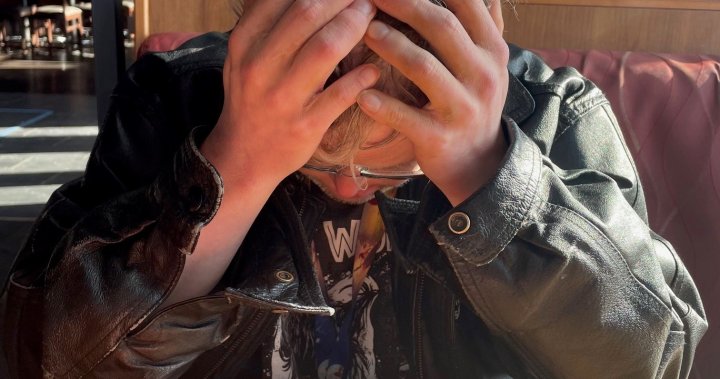
Cory Kadlec has been in hospital so long, his family said, his health isn’t getting better, it’s getting worse.
He’s been in a hospital in Saskatoon since June 11, 2022, after he had a seizure, according to his sister Tara Jo.
Cory and his family say the long hospital stay is hurting his recovery. He can’t spend time with friends and live the independent life he is capable of living. They said his mental health is deteriorating.
Story continues below advertisement
Cory wants to return to a care home, like one he lived at before he had the seizure. But care homes said they can’t accommodate Cory’s complex health needs, the family says.
According to his family, the only option the Saskatchewan Health Authority (SHA) and Ministry of Social Services (MSS) offered is even worse – a long-term care dementia ward.
‘There’s no way my brother will survive in there mentally,” Tara Jo said, speaking from her home in Calgary. “Not one minute.”
She said the other patients in the long-term care (LTC) facility have late-stage dementia that is much worse than Cory’s early-stage affliction.
Health News: Treating depression can reduce risk of dementia
According to the Alzheimer’s Society of Canada, patients with early-stage dementia can have difficulties communicating and forget things but “retain many of their abilities” whereas people with mid- and late-stage dementia may require “(a)ssistance with daily tasks,” such as dressing and using the bathroom, and can require care 24 hours a day.
Story continues below advertisement
Tara Jo said Cory does need access to round-the-clock care, but not for his dementia. Rather, for his diabetes, which can require several doses of different types of insulin every day.
She said putting Cory in the LTC would mean he is isolated and wouldn’t be capable of enjoying his life.
Cory Kadlec says he hates waiting in the hospital. He wants to go back to a group home but his family says the Saskatchewan Health Authority won’t provide the medical support he needs.
Tara Jo Kadlec / Supplied
“He actually needs an appropriate home for his medical needs as well as what he deserves as a human to live the life that he still has,” she said.
She told Global News Cory wants a room of his own where he can still be independent.
Tara Jo, who is Cory’s legal guardian along with their father, said only two care homes contacted the family and both said they are unable to accept Cory because they can’t accommodate his medical needs.
Story continues below advertisement
The Saskatchewan Ministry of Social Services provides funding through partnerships with many care homes across the province, including group homes, group living homes and day programs.
Tara Jo said she was told repeatedly by SHA and MSS officials that the SHA must fund medical care administered in group homes.
Tara Jo said she had hoped the Ministry and Authority would work together to help Cory.
“They said the only option we’re giving you is long-term care,” she said.
Global News asked Elmwood Residences Inc., the Saskatoon-based organization that operates the care home where Cory was living prior to suffering the seizure, for an interview.
Rachael Steinke, the executive director, provided a statement in which she specified confidentiality prohibited her from speaking about specifics of Cory’s case.
“Elmwood recognizes and experiences gaps between human service systems where one Ministry or Authority ends, and another begins,” she wrote.
The statement also said “(l)ong standing funding issues for Community-Based Organizations in the Disability Service Sector and provincial recruitment initiatives for the Health and Education sectors widen the gaps and cause significant recruitment and retention issues.”
Story continues below advertisement
“It is Elmwood’s deep hope that the service gaps are recognized and addressed to ensure all individuals with intellectual disabilities have their needs met seamlessly and without delay.”
Questions raised after development disabled adult sent to Saskatchewan Prison
Tara Jo told Global News MSS did offer to pay for a support worker for 40 hours a week. She said it helps but 40 hours isn’t enough.
She also said the family sought to have MSS re-evaluate Cory after his stroke to see if he qualified for more benefits. She said officials told the family they won’t re-evaluate him until he’s stabilized from the stroke – which Tara Jo said can’t happen while he’s in hospital.
She said the family can’t afford to pay for Cory’s care and they’re unable to care for him themselves because they lack the training and don’t all live in Saskatchewan.
Story continues below advertisement
Tara Jo said they’d consider moving him to Alberta, but Alberta officials told her they need to evaluate Cory in that province – which would require the family to move Cory and care for him while they wait for the evaluation process and housing to become available.
Bluesette Campbell, the president of Inclusion Saskatchewan, an organization that works to support individuals with intellectual disabilities, said she’s heard of many people waiting a long time for appropriate housing.
Cory Kadlec in a Saskatoon hospital. His family told Global News they brought him many of his things from his group home so he would be more comfortable.
Tara Jo Kadlec
Speaking generally about the support available, she said the system is reactive, “which is… you have to sit there and wait. I don’t find that acceptable.”
Part of the problem is a lack of housing across all sectors, she said.
She also said the division of responsibility between ministries can contribute to inadequate care.
Story continues below advertisement
“What we recognize is this… cross-section or cross-cutting of responsibilities that don’t necessarily fall neat and tidy into one silo,” she said.
She said any solution must involve speaking to people with intellectual disabilities and asking what they want.
“I believe that everyone, regardless of their age or their abilities, has that right to have a place where they are safe and feel (at) home.”
When asked about his time in the hospital in an interview, Cory told Global News, “I hate this.”
Bob Martinook, the executive director of the social service ministry’s community living service delivery, in a statement said “we want Cory Kadlec and his family to know we understand their concerns and are here as a support.”
The statement said the ministry couldn’t speak to specific cases due to privacy concerns, but did say planning is an ongoing process with regular reviews to ensure appropriate supports are being provided.
David Freeman, an SHA media relations specialist, also cited privacy and would not speak about Cory’s situation.
His statement said the Health Authority weighs all patient care needs and best matches the individual’s needs – both medical and social, in the case of long-term care or community living placement – with the care options available.”
Story continues below advertisement
“We take all care concerns from patients and their family members very seriously.”
Tara Jo said she doesn’t know how to get Cory the care he needs. For now, it appears he’s stuck in the hospital.
“I feel broken. My family feels broken, but most of all, my brother is broken,” Tara Jo said.
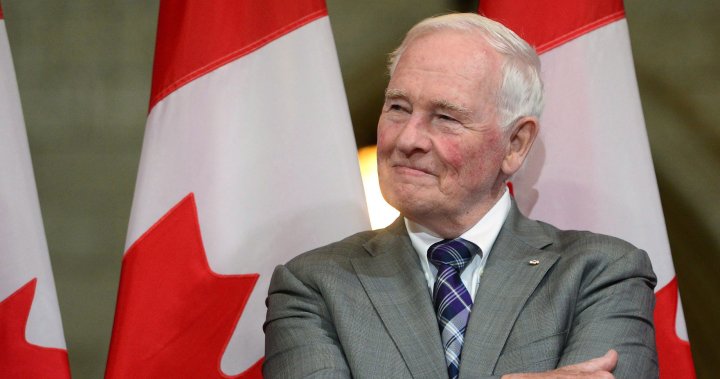
David Johnston will take up the post as Ottawa’s “special rapporteur” to investigate allegations of foreign interference in Canadian elections and society.
Johnston, who served as the nation’s governor general from 2010 to 2017, was named by Prime Minister Justin Trudeau on Wednesday as the prominent Canadian who will probe the interference issue and make recommendations to the federal government on how to handle it.
The Liberal government has been under immense pressure to explain what it knew about foreign interference in the 2021 election after the Globe and Mail reported last month that intelligence sources said China attempted to interfere in that campaign to help the Liberals win another minority government.
Story continues below advertisement
That report came after months of revelations from Global News about allegations of Chinese interference in the 2019 election.
Trudeau recently announced a slew of investigations into the matter, but the creation of the special rapporteur position was billed by the government as a key measure.
Singh commends Trudeau’s choice of David Johnston for special rapporteur: ‘integrity, non-partisan, trustworthy’
Now that Canadians know who the government’s rapporteur will be, here’s a look at Johnston’s background and the work he’s expected to do.
Johnston, 81, was named as governor general by then-Conservative prime minister Stephen Harper in 2010, and his term was extended when Trudeau was elected in 2015.
Story continues below advertisement
He left Rideau Hall in 2017 and currently serves as the Leaders’ Debates Commissioner, which arranges debates during Canada’s federal elections. He will step down from that position to take on the rapporteur role, the Prime Minister’s Office (PMO) said in a statement on Wednesday.
NDP MP pushes for public inquiry on election interference
Prior to his role as governor general, Johnston was a professor of constitutional law for 45 years and is a highly respected Canadian legal scholar. He has also chaired or served on many provincial and federal task forces and committees, and has served on the boards of more than a dozen public companies, the PMO said.
In 2007, Harper named Johnston as a special advisor charged with drafting the terms of reference for a public inquiry into the Airbus affair, which became the Oliphant Commission.
He’s also an author, with 25 published books and a new one looking at the role of empathy in Canadian society released in January 2023.
Story continues below advertisement
Johnston is also a member of the Pierre Elliott Trudeau Foundation, according to the organization’s website. The charity recently made headlines after it returned a $200,000 donation it received seven years ago following a Globe and Mail report alleging a potential connection to Beijing.
The foundation funds awards and fellowships for doctoral research in the social sciences and humanities. Other members of the foundation include Trudeau’s brother, Alexandre Trudeau, along with prominent current and former leaders from financial institutions, top universities, a former Saskatchewan premier, constitutional experts, lawyers and writers. Its board of directors includes the former lieutenant governor of Nova Scotia, a former mayor of Iqaluit, and leaders from prominent Canadian universities and firms.
It is funded mainly through a $125-million endowment received from the federal government in 2002 and like all registered charities in Canada, is prohibited by law from engaging in any political activity, including funding any entity — parties, candidates, nominees, riding associations – registered with Elections Canada
Prime Minister Justin Trudeau has had no involvement with the foundation, set up in his late father’s memory, since 2013.
What will he do as special rapporteur on foreign interference?
According to the PMO, Johnston will have a “wide mandate” to investigate foreign interference in the last two federal elections, and will make recommendations “on how to further protect our democracy and uphold Canadians’ confidence in it.”
Story continues below advertisement
Whether an inquiry should be called, or if a different kind of independent process like a judicial review is more appropriate, will be one of the questions Johnston will have to decide.
Opposition criticizes Trudeau’s plan to probe foreign interference
Opposition leaders and outside experts have been calling for the federal government to launch a public inquiry into the matter. Instead of calling one, Trudeau tasked the special rapporteur with the responsibility to recommend one or not.
The PMO said the federal government will “will comply with and implement his public recommendations, which could include a formal inquiry, a judicial review, or another independent review process.”
His mandate will be finalized in the coming days, it added.
Trudeau has also tasked the National Security and Intelligence Review Agency and the National Security and Intelligence Committee of Parliamentarians with probing foreign interference in the last two elections, as well as other ongoing processes.
In addition to those measures, Johnston will “identify any remaining gaps or areas requiring further attention to protect the integrity of Canada’s democracy,” the PMO said.
How long will his work take?
It’s unclear how long Johnston will serve in the role, but the federal government has been under pressure to act quickly.
Meanwhile, political reaction to Johnston’s naming has been pouring in.
Conservative Leader Pierre Poilievre has previously scoffed at the idea of a special rapporteur, saying it sounds like a “fake job,” and doubled down on the need for a public inquiry in the name of transparency.
Foreign election interference: Singh calls for public inquiry, accuses Trudeau of ‘playing political games’
In a statement Thursday, Poilievre said Trudeau must “end his cover up,” and criticized the prime minister for tapping another Trudeau Foundation member.
Story continues below advertisement
Despite Johnston being named as governor general under a Conservative prime minister, Poilievre’s tweet echoes opposition attacks on the government’s appointment of Morris Rosenberg, a former senior public servant and CEO of the Trudeau Foundation, to author a report into foreign interference in the 2021 election.
It was released last month, and he determined that there was no foreign interference that “threatened Canada’s ability to have a free and fair election” in 2021, while noting there was foreign interference that did not meet the threshold of alerting the public.
The PMO stated Johnston’s naming to the role followed “consultations” with all parties in the House of Commons.
On Thursday Bloc Quebecois Leader Yves-François Blanchet said Johnston is “close” to Trudeau, and called the idea a “superfluous” waste of time, since opposition parties will still demand a public inquiry.
Trudeau to appoint special rapporteur to probe foreign election interference
NDP Leader Jagmeet Singh said on Thursday that Johnston is someone of “integrity,” and called his appointment a “positive step.”
Story continues below advertisement
However, he said he wants to ensure Johnston’s mandate is broad enough.
“I do want to make clear that I want to make sure that that Mr. Johnston has a broad enough mandate to answer the fundamental questions that Canadians have: What did the Prime Minister know, when did he know it and what did he do about it when it comes to foreign interference?” he said.
“I still believe that Mr. Johnston has to launch a public inquiry to have that public and independent response that provides Canadians with confidence in our electoral system.”
Meanwhile, Trudeau said in a statement Wednesday that Johnston “brings integrity and a wealth of experience and skills” to the role.
“I am confident that he will conduct an impartial review to ensure all necessary steps are being taken to keep our democracy safe and uphold and strengthen confidence in it,” he said.
The two entities were exploring sharing a building at the site of the new city centre school, which combines the Princess Alexandra, King George and Pleasant Hill schools in a new building at the Princess Alexandra location in downtown Saskatoon.
But Saskatoon Tribal Chief Mark Arcand told Global News it became clear the site was not large enough for the new school and the drop-in youth recreation centre.
“We want to get into two large gyms because (of) the number of kids that we’re seeing… we want to see more multipurpose rooms, to have more activities,” Arcand said, adding the activities could include things like elder services, education or painting.
Story continues below advertisement
The Saskatoon Tribal Council (STC), City of Saskatoon, Central Urban Métis Federation Inc. (CUMFI) and the Saskatchewan Health Authority operate the lodge.
Arcand said the lodge received around 30,000 visits from kids annually in the years before the COVID-19 pandemic.
He said it’s time to expand and update the facility, which opened in 1999, to continue to help kids in Saskatoon’s urban core.
“When kids don’t have a place to go, maybe they’re wandering the streets and they shouldn’t be. They could be in the gymnasiums playing basketball, playing volleyball for hockey, just doing something positive,” he said.
Challenges and opportunities of wellness centre: Saskatoon Tribal Council
The city’s planning, development and community services committee is scheduled to receive a report on the matter on Wednesday.
Story continues below advertisement
The report estimates the cost for a new lodge at the current location between $15 and $20 million. It also states the City applied to a grant program through Infrastructure Canada to help fund construction.
The report states the next steps, pending the committee’s and then city council’s approval, are to have the partners develop an agreement for running the new WBYL.
It does not provide a timeline.
Arcand said he hoped a new lodge could be operating by 2025 if not sooner, though he said it depends on what funding is available.
As health-care concerns continue in Saskatchewan, a voice for smaller communities said more needs to be addressed in rural parts of the province.
“It’s really an integrated system, and when part of the system fails it puts pressure on the other one. So we believe if more can be done in rural Saskatchewan, we can actually take pressure off the larger urban centres,” said Ray Orb, president of the Saskatchewan Association of Rural Municipalities (SARM).
Orb said they’ve seen a lot of emergency centres close in rural areas.
He added that there’s poor communication between the Saskatchewan Health Authority and rural municipality residents as far as delivering care.
Story continues below advertisement
“We know there are physician shortages out there in rural Saskatchewan, and really across the province.”
He said there is a shortage of nurses as well.
“People really are forced to travel to urban centres, and we believe more can be done in the rural areas to help alleviate the problem.”
Orb said this becomes a problem during seeding and harvest, noting that farm accidents are a concern, and many paramedics are wrapped up with patients at hospitals.
Minister of Health Paul Merriman said he has reached out to Orb to discuss some of the issues he brought up.
“We know there are some disruptions in rural Saskatchewan. I think we’ve made some strides forward in the last six months as reopening some (ERs) that were disrupted during COVID-19, and we had to replace some of the staff,” Merriman said.
He agreed that if issues in rural Saskatchewan don’t get addressed, it will roll over into urban centres, creating more stress on hospital capacity.
Merriman said over the last 18 months, the province is up 160 doctors, but added that there are still staffing challenges.
“There are still some gaps that we’ve identified,” Merriman said.
“We just had last week three Filipino nurses that had arrived in Regina and went out to western Saskatchewan into Swift Current, East, and areas where we had some gaps.”
He said they are actively recruiting specialists in Saskatchewan, and have been for a long time, noting they brought over about 62 specialists in the last two years.
“When we have a lack in one specific area then we actively recruit.”
He said they’ll also make agreements with other provinces to send patients out if they can’t offer a treatment in the province.
“Which isn’t ideal, but at least they’re still getting their treatment.”
Ford government polled Ontarians asking about private health care, if system in crisis
“A total of six lab sites will go live by April 2023 including Moose Jaw (3 sites), North Battleford, Prince Albert, and Swift Current,” stated SHA.
Patients would be able to book appointments online for blood and urine collection, ECG, blood and urine collection and ECG and glucose tolerance test.
The executive director for the SHA’s Laboratory Medicine Clinical Services stated this upcoming expansion will be a huge step forward in their efforts to maximize efficiency and ensure safety in the delivery of lab services.
Story continues below advertisement
“This is an exciting development for all patients, families, and staff in Saskatchewan,” said Lenore Howey. “Booking online only takes a few minutes, making things simple and fast for those who are scheduling their appointments.
“Users who aren’t comfortable with, or don’t have access to technology can book by phone.”
SHA stated that not all laboratory locations or tests can be booked online at this time; appointments will be phased into SHA Lab locations provincially.
The online booking system can be found at SHA Patient Booking System. Patients will need a valid health card and a phone number or an email address to book appointments using the new online system.
SHA stated that lab appointments in Saskatoon and Regina can still be made by booking online and they can also call a booking agent for help with their appointment. The call centre operates 8:45 a.m. to 4:45 p.m., seven days per week, and can be accessed by calling 1-833-727-5829.
Saskatchewan Health Authority urging people to get flu shots
Despite struggling with memory loss, fatigue and other symptoms associated with brain damage, Saskatoon resident Brennon Dulle is advocating for brain surgeries to be performed in Saskatchewan after having to travel to Calgary for the last two he had.
Dulle has had four brain surgeries after having a stroke and aggressive seizures.
He is putting together a fundraiser for the Royal University Hospital Neurology Ward on May 20 at TCU Place, noting there will be food, entertainment, door prizes and raffle draws.
“Anything would be nice for the doctors and nurses,” Dulle said, adding that he’d like to raise $10,000 if he could.
Jennifer Molloy is the CEO of the Royal University Hospital Foundation and said they are glad to have the support.
Story continues below advertisement
“We feel really grateful to have the support of Brennon, a patient that’s gone through a lot through the hospital system, and in turn has offered to make this extremely generous gift through really getting the community engaged and behind him to give back to the neurology department,” Molloy said.
Dulle said he had an arteriovenous malformation (AVM) stroke, and had a couple of surgeries in Saskatchewan, but his case was beyond local capabilities.
“I had to get my last two brain surgeries done in Calgary because we can’t do them in Saskatchewan … I had to get 15 electrodes planted into my head.”
The aftermath of Brennon Dulle’s brain surgery.
Brennon Dulle
According to the American Stroke Association, arteries carry blood containing oxygen from the heart to the brain, and veins carry blood with less oxygen away from the brain and back to the heart. An AVM is where a tangle of blood vessels in the brain will bypass normal brain tissue and divert blood from the arteries to the veins.
Story continues below advertisement
The association noted that around 20-25 per cent of AVM patients suffer from focal or generalized seizures.
Dulle said he didn’t deal with seizures for about a year and a half after his second surgery, but then he started getting severe ones.
“I got seizures again, and then they became hardcore, really bad,” he said.
The aftermath of Brennon Dulle’s brain surgery.
Brennon Dulle
“I’ve had a couple of seizures that were an hour and 45 minutes long.”
He said he’s had somewhere between 500 and 600 seizures.
He noted he had to be placed into a coma that lasted days due to one of his seizures, later being brought out of the coma with the hopes that he wouldn’t have a seizure again.
Story continues below advertisement
Dulle said he advocated to the provincial government because the surgery he needed wasn’t available in Saskatchewan, which resulted in his surgeries in Calgary. He said that this has impacted every part of his life.
He said he takes more than 27 pills a day for his seizures, he’s fatigued, he can’t drive, he can’t work, and his time right now is spent focusing on his fundraiser.
“I don’t know if I’ll ever work, so I plan on doing this for the rest of my life.”
Gillian Dulle, Brennon’s wife, said this journey has been a tough one, but said she’s there to support Brennon.
Story continues below advertisement
“When you commit to somebody, you commit. And Brennon has supported me through things, my career, my army career, a couple of tours to Afghanistan, and now it’s my turn to support him.”
She said it is difficult, but this journey has created resiliency within both of them.
Gillian said they like to travel, but bucket list destinations are off the table until they know Brennon’s health is stable.
“We were at Lake Diefenbaker camping one weekend and Brennon had a seizure that lasted an hour and 45 minutes, and we had to have STARS called to evacuate him out of there so they could get to the ICU.”
She said there are phenomenal doctors and nurses in the province that have been with them on this journey.
Gillian had advice for anyone else with someone in their lives: you need to take time for yourself.
“You can only support the person you’re supporting if you’re at your best.”
“Make sure you’re getting enough rest, exercise, eating right, so that you aren’t taken down with exhaustion and stress at the same time,” Gillian added.
Story continues below advertisement
She said just being there is important, adding that you can’t fix everything.
“Sometimes it’s just being there to hold a hand and remind them that things are going to be OK.”
Global News received a statement from the Saskatchewan Health Authority (SHA).
“Patients requiring electroencephalography (EEG), and particularly surgically implanted EEG electrodes (DEEG) is currently limited in Saskatchewan, which means that patients are currently travelling outside of Saskatchewan to access this procedure,” read the statement.
The authority said expanding access to this type of treatment is a priority for both the SHA and the government of Saskatchewan.
“The Saskatchewan Ministry of Health is supporting the SHA to stabilize its neurosciences program through specifically targeted recruitment, enhanced staffing and training for physician providers. Over the past year the health system has put a significant focus on recruitment and continues to prioritize the expansion of new treatments and surgeries within the province.”
“The Ministry of Health is collaborating with the Ministries of Advanced Education, and Immigration and Career Training on recruitment, retention, and training strategies to address the health human resource priorities of Saskatchewan. The Government of Saskatchewan is also establishing an independent agency dedicated to the recruitment and retention of doctors, nurses, and other high-priority professions.”
Saskatchewan’s health minister defends province’s private, public health-care policies
Saturday marks the 3rd anniversary of when Saskatchewan declared a state of emergency for the COVID-19 pandemic, but experts say the virus is still hanging on.
“It has stabilized, but it’s stabilized at a pretty moderate, to moderate high level, which is not where we want to see it,” said Dr. Cory Neudorf, professor of community health and epidemiology at the USask College of Medicine.
Neudorf said a persistent level of COVID-19 is putting a strain on the hospital system, adding it’s pushing beyond the normal urgent levels and into teetering close to crisis.
He said major tertiary hospitals are seeing a lot of overcapacity beyond what you’d normally expect.
Story continues below advertisement
“We can’t maintain this level of usual pressure plus COVID-19 pressures without having negative impacts on staff and patients.”
Stats from the province’s CRISP reports shows that persistence, with staffed COVID-19 inpatient beds consistently hovering around five to six per cent between Jan. 19 to March 16, deaths hovering around under 20 people per report, and the population of residents with up to date vaccinations stagnating around 46 per cent.
Neudorf said the consistent levels of hospitalization and deaths is still concerning, but that it’s not as high as the peak of the pandemic.
“We lose track of the fact that less than 20 (deaths) per reporting period translates to one or more deaths per day happening due to COVID-19 still, which is still very concerning.”
He added we’ve become numb to that.
Study shows COVID had little impact on mental health. The same isn’t true for kids
Neudorf said they are seeing a recent uptick in middle aged residents being admitted to the ICU, suggesting that the subvariant XBB 1.5 has been slowly gaining ground.
Story continues below advertisement
He said they don’t look at testing results anymore, noting they’ve had to watch wastewater results instead.
“Just like winter is hanging on, COVID-19 is hanging on as well.”
He said to expect this consistent level of the virus in the short to medium term through the spring.
Neudorf said he’s disappointed to see the lack of uptake for the bivalent booster, reiterating the message that the booster better protects against these subvariants, which he says are finding ways around the vaccine to cause an infection.
He said people should stay home if they’re sick, but said he recognizes there have been so many respiratory viruses making the rounds.
“I think what has happened is because we have so many respiratory viruses going around right now, for parents who have been doing that, or if you have had to stay home, it’s a lot of sick time. And so, employers also need to be continuing to support this hybrid working arrangements if you can.”
Neudorf said we should expect to see a seasonal ebb and flow of infection, with summer seeing cases go down, and winter seeing cases go back up, adding that this could continue for several years.
Story continues below advertisement
Dr. Julie Kryzanowski, deputy chief medical health officer in Saskatchewan, said the CRISP report looks at respiratory illnesses across the board.
She said the burden of respiratory illnesses as a whole is trending down right now, but COVID-19 has stabilized.
Kryzanowski added modelling shows that we should continue to see COVID-19 transmission over the next weeks and months, but nothing extreme.
“There is nothing pointing to another wave at this point and time.”
She said she couldn’t speak to hospital overcapacity, but noted that the Saskatchewan Health Authority’s (SHA) analytics teams are looking at CRISP reports to help forecast bed utilization.
Calgary seniors centre salutes service of volunteers during COVID-19 pandemic