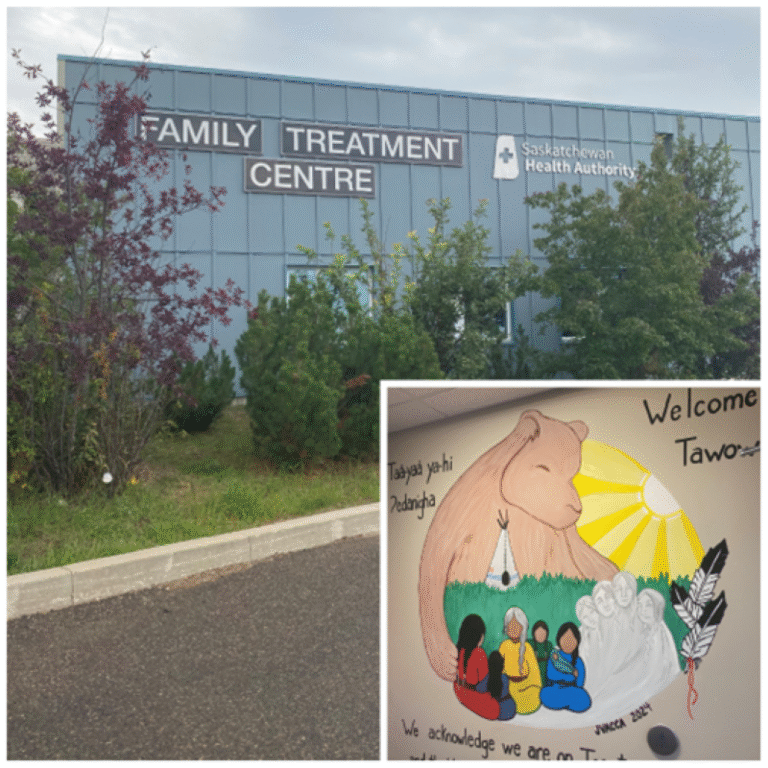
Saskatchewan women with children 12 and under experiencing barriers to accessing addictions treatment can participate in a holistic, family-oriented six-week inpatient program through the Saskatchewan Health Authority’s (SHA’s) Family Treatment Centre in Prince Albert.
Clients motivated to take the first step toward stopping the cycle of substance use can attend a mix of one-on-one and group programing and family activities to start managing their addiction and empower them to make changes that will help them lead healthier lives. Female caregivers and their children live, learn and heal as a family unit, with programming focused on the four key elements of recovery: spiritual, emotional, mental and physical health.
Rooted in a trauma-informed approach, the program reflects SHA’s commitment to its CARES values, creating a compassionate, respectful, safe and inclusive environment that recognizes and supports both the individual and family recovery journey.
SHA health-care professionals, community-based organizations, partner organizations and stakeholders are encouraged to refer eligible clients to the program. Up to eight families can access the program through a continuous intake model. More information on referrals, intake and programming is available on the SHA website.
The Prince Albert Family Treatment Centre is situated on the Victoria Hospital campus in Prince Albert. The bright, welcoming space provides trauma-informed care to women and their children from across the province through culturally responsive healing and empowerment. The treatment centre has capacity for up to eight female caregivers and children and accepts eligible clients through continuous intake.
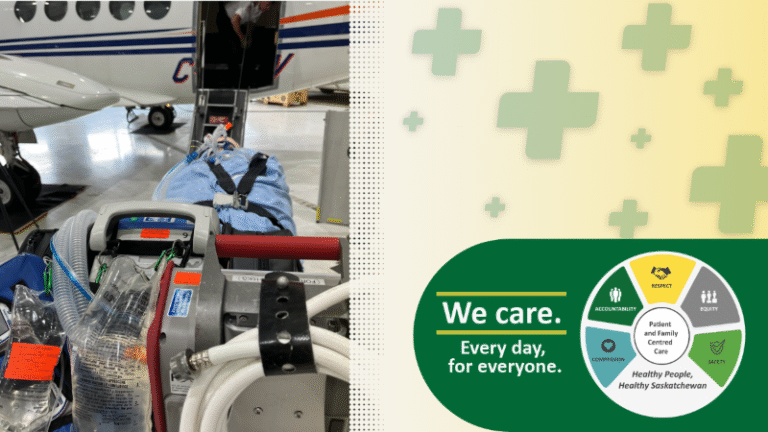
A Saskatchewan Air Ambulance aircraft has been upgraded to better meet the needs of all patients — especially those with more complex and urgent health issues.
The Saskatchewan Health Authority (SHA), working with SaskBuilds and Procurement, saw an opportunity to enhance the Saskatchewan Air Ambulance aircraft to include a larger cargo door, a bigger stretcher, a new support system, and an electronic lift.
The aircraft upgrades highlight both safety and equity — two of the SHA’s CARES values (compassion, accountability, respect, equity and safety) — by increasing the ability of the Saskatchewan Air Ambulance to provide safe and efficient specialized critical care air transport to more people throughout the province.
Saskatchewan Air Ambulance has been providing rapid air transport and care to patients in all corners of the province since 1946. It’s a vital service experiencing increased demand in recent years.
Watch this video to learn more about the upgrades to the Saskatchewan Air Ambulance aircraft.
The Saskatchewan Health Authority has expanded its online Patient Booking System to include lab appointments in Estevan and Weyburn. This tool enables patients to book appointments for blood and urine collection, electrocardiograms (ECGs) and glucose intolerance testing online.
Booking opens for both communities on October 1, with appointments available starting October 7 in Estevan and October 8 in Weyburn.
The SHA Patient Booking System is the fastest way to book a lab appointment and is available 24 hours a day, seven days a week. To book your appointment using the online system, you need:
a valid health card; and
a phone number or email address to receive notifications.
If you do not see your desired appointment type or location, or if you require further assistance, call thePatient Booking System Call Centre Monday through Friday from 8:45 a.m. to 4:45 p.m. (closed statutory holidays) at 1-833-727-5829. Walk-in appointments will continue to be available on a first-come, first-served basis at all testing locations.
“Usually, individuals pick their own medicines,” explained Holden Cronin, manager with First Nations and Métis Health in Regina. “But people in the hospital can’t do that. When we pick, we pick for our patients, so they have access to traditional medicines they need while in hospital.”
Sage is used in smudging ceremonies, for spiritual cleansing and to help people connect to the Creator. First Nations and Métis Health teams also make and use sage spray, noted Paula Jacobs, manager of First Nations and Métis Health in Saskatoon.
“Families ask for the spray when their loved one is on life support and smudging isn’t possible,” explained Colleen Chief, Knowledge Keeper and Cultural Support Worker with First Nations and Métis Health in Saskatoon.
Members of First Nations and Métis Health teams in Saskatoon and Regina scouted areas for sage and made offerings to those who allowed them to harvest there.
“A nurse at St. Paul’s Hospital in Saskatoon, Samantha, was more than happy and willing to provide her space for the sage harvest this year,” said Jacobs.
They follow traditional ceremonies when gathering the medicine.
“Before we work with the plants, we smudge ourselves,” explained Leo Yahyahkeekoot, Knowledge Keeper and Cultural Support Worker in Saskatoon.
Smudging is just one of many cultural supports offered by the First Nations and Métis Health team, who embed the SHA’s CARES values of compassion, accountability, respect, equity, and safety, in all they do.
Teams from Saskatoon and Regina harvested sage using traditional methods over the summer. The sacred medicine will be used to comfort patients and families throughout the rest of the year.
In the small town of Porcupine Plain, the Saskatchewan Health Authority’s (SHA) new virtual physician (VP) initiative has been generating positive results. The VP program, implemented as a temporary measure, has proven to be a helpful tool for the community, keeping emergency room (ER) services open when local physician coverage is unavailable.
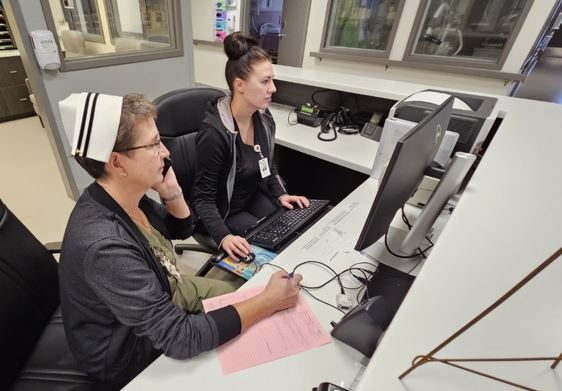
Registered nurses (RNs) have been able to virtually access physicians located elsewhere in the province, allowing for the assessment and treatment of patients, even when a local physician is not available.
“Limited physician coverage at times over the summer and fall could have led to ER disruptions but thanks to VP, we’ve kept our doors open. It’s been a game-changer.”, said Cheri Thorpe, Licensed Practical Nurse.
Patients presenting at the ER are triaged by an RN, who then collaborates with a physician virtually to ensure the appropriate course of action. This approach has enabled patients to receive timely treatment, schedule follow-up care with local physicians, or, if necessary, have transport arranged to another facility equipped to meet their needs.
“Our remarkable health-care workers have demonstrated unwavering resilience. Despite initial reservations, they have embraced innovation for the betterment of our patients,” said Rhonda Teichreb, Director of Primary Health Care, “Their dedication is evident in how smoothly this program has been implemented.”
Porcupine Plain’s story highlights the important of innovative solutions in health care, especially in areas with staffing challenges. Although temporary, the VP program exemplifies the SHA’s commitment to uninterrupted access to emergency care.
Dedicated Porcupine Plain registered nurses collaborating virtually with physicians from afar, ensuring patients receive the care they need when it matters most.
With the support of the Government of Saskatchewan, the Saskatchewan Health Authority (SHA) has reached an agreement with Eden Care Communities that will enable Regina Lutheran Home (RLH) to remain open. Eden Care Communities will continue to operate RLH on a transitional basis while ownership of the facility is transferred to the SHA.
The Government of Saskatchewan is providing $1.7 million in new annual funding to Family Service Saskatchewan to expand its free, rapid access counselling services to children, youth and their caregivers across the province. Kindersley, Leader, Unity, Rosetown and Biggar are the newest communities to launch these services.
How are we supposed to take these climate conferences seriously when in their wake oil production and carbon levels keep on rising?
The literature is also telling us that we can’t solve the climate crisis without eliminating, or at least radically decreasing, inequality; and, as far as I can tell, the people attending these conferences have no intention of giving up the privilege afforded them by the burning of fossil fuels.
Article content
They are simply looking to make themselves feel good, giving the impression of doing something while continuing to grind the climate and all that supports life on this planet into dust under their feet. Judging from the results of past COP conferences, the best thing we could do for the climate is not to have them.
It would save a lot of emissions and show a sincerity of intent if the conference was held over Zoom, instead of zooming around in private jets.
The million bucks our provincial government will likely spend on attending COP28 is just more political tourism and corporate welfare on the taxpayer’s dime, masquerading as promoting green aspects of Saskatchewan business.
Provincial officials say they’ve picked a “nationally recognized” third party to run the facility, but will not yet say who it is.
Published Nov 22, 2023 • 5 minute read
Saskatoon city council approved on Nov. 22 an 18-month window for the province to operate a 15-bed emergency shelter at 1701 Idylwyld Drive North for people with “complex needs.”Photo by ROB O’FLANAGAN /Saskatoon StarPhoenix
Article content
Saskatoon city council spent the bulk of its Wednesday business meeting addressing an application from the provincial government to set up a temporary emergency shelter for some of the city’s hardest-to-house people.
The city last week issued notices to residents and businesses within a few hundred metres of 1701 Idylwyld Drive North, indicating the province is seeking to use it for a 15-bed facility for people with “complex needs,” a term generally applied to people with mental health or addictions challenges that make them a potential danger to themselves or others, and who cannot be housed at existing facilities, other than police detention cells.
Advertisement 2
This advertisement has not loaded yet, but your article continues below.
THIS CONTENT IS RESERVED FOR SUBSCRIBERS ONLY
Subscribe now to read the latest news in your city and across Canada.
Unlimited online access to articles from across Canada with one account.
Get exclusive access to the Saskatoon StarPhoenix ePaper, an electronic replica of the print edition that you can share, download and comment on.
Enjoy insights and behind-the-scenes analysis from our award-winning journalists.
Support local journalists and the next generation of journalists.
Daily puzzles including the New York Times Crossword.
SUBSCRIBE TO UNLOCK MORE ARTICLES
Subscribe now to read the latest news in your city and across Canada.
Unlimited online access to articles from across Canada with one account.
Get exclusive access to the Saskatoon StarPhoenix ePaper, an electronic replica of the print edition that you can share, download and comment on.
Enjoy insights and behind-the-scenes analysis from our award-winning journalists.
Support local journalists and the next generation of journalists.
Daily puzzles including the New York Times Crossword.
REGISTER TO UNLOCK MORE ARTICLES
Create an account or sign in to continue with your reading experience.
Access articles from across Canada with one account.
Share your thoughts and join the conversation in the comments.
Enjoy additional articles per month.
Get email updates from your favourite authors.
Article content
Article content
The proposed facility is part of a $90 million package aimed at addressing mental health, addictions and homelessness announced by the province in October.
Between Leslie Anderson, the city’s director of planning and development, and city solicitor Cindy Yellend, council members heard a temporary emergency shelter is a permitted use under the property’s zoning.
As such, council was told there is no option to reject the province’s application — only to set a timeframe of between one and 18 months for the proposed emergency shelter to operate.
Yellend further clarified that setting a zero-month timeline would amount to council acting in bad faith, while noting such a decision could be appealed.
Council heard a presentation from Chad Ryan, executive director of the organization strategic management branch of the Ministry of Social Services; he was joined by representatives from Social Services and the ministries of Corrections and Health.
Council learned the province has selected what Ryan described as a “nationally recognized” third party to run the proposed site. The third party operator is to provide the full complement of medical and security staff.
Afternoon Headlines
Get the latest headlines, breaking news and columns.
By signing up you consent to receive the above newsletter from Postmedia Network Inc.
Thanks for signing up!
A welcome email is on its way. If you don’t see it, please check your junk folder.
The next issue of Afternoon Headlines will soon be in your inbox.
We encountered an issue signing you up. Please try again
Article content
Advertisement 3
This advertisement has not loaded yet, but your article continues below.
Article content
The provincial representatives declined to name the provider, citing ongoing contract negotiations. That information is expected in early 2024, before the projected opening of the facility.
Ryan noted the proposed facility will be operated as a pilot project. Unlike the 12-bed brief detox unit currently operated by the Saskatchewan Health Authority on Avenue O South, clients won’t be able to “self-refer” — they can only be brought in by police.
Council heard people arriving at the facility will be considered to be in custody, and can be held there for up to 24 hours.
Council heard the facility operator will seek to provide a “warm handoff” of clients after 24 hours, including transportation to another shelter, a family member’s home, or other suitable location. However, Ryan acknowledged there is no guarantee some clients won’t refuse services and end up released into the surrounding community.
Saskatoon Mayor Charlie Clark, in this file photo from December 2022, discusses the challenge of finding housing for individuals with severe mental health and addictions challenges. Photo by Matt Smith /Saskatoon StarPhoenix
Council also heard from about a dozen speakers, mostly residents and business owners from the area near the proposed shelter site.
Most criticized the process leading to Wednesday’s vote, noting they received only a few business days’ notice, and questioned the suitability of the site, noting its proximity to homes and businesses.
Advertisement 4
This advertisement has not loaded yet, but your article continues below.
Article content
Tony Badger, owner of a British café across the street from the proposed site, was moved to tears as he described his concerns about safety for his staff and customers. Another speaker who has worked for decades at a nearby restaurant lamented that, if the facility is allowed to proceed, the slogan “Saskatoon Shines” could come to refer to sunlight glinting off of streets littered with discarded needles.
The decision by city staff to distribute the mailout announcing the province’s application also appeared to create confusion among residents about which order of government is responsible for the proposed shelter; some speakers reported that provincial MLAs contacted about the issue told them to contact the city.
Council heard the province picked the site of the proposed shelter without any input from the city, with an eye to using buildings it already owns. Ryan said this was done to get the new facility running as soon as possible.
The city will have a hand in picking sites for two additional 30-bed facilities the province also plans for Saskatoon; these will not be complex needs beds, and the city will not be responsible for operating either facility when they open. To date, no locations for these sites have been announced.
Advertisement 5
This advertisement has not loaded yet, but your article continues below.
Article content
Council voted 10-1 in favour of granting the full 18-month operating window for the proposed facility.
Coun. Darren Hill was the lone opposing vote. During the meeting, he attempted to introduce a motion to limit the facility’s operation to six months, but did not find a seconder. He said he would have supported 18 months if the province had included a guarantee that people discharged from the facility would be transported elsewhere. Hill went on to encourage nearby residents and business owners to pressure their provincial representatives on this point.
Coun. Randy Donauer supported the 18-month operating window. However, he also said he feels it’s likely council would simply be brought back to approve an extension of any shorter period, and would be just as restricted in the decisions available to it, as provincial law requires council to respect the current zoning.
Mayor Charlie Clark noted the city has asked the province to step up its efforts to address crises in homelessness, addictions and mental health. He said he doesn’t believe there’s any potential site in the city that wouldn’t come with similar concerns for nearby residents.
Advertisement 6
This advertisement has not loaded yet, but your article continues below.
Article content
No facility — not even the police detention cells — can guarantee someone refusing further help isn’t discharged directly into the community, Clark added.
Council unanimously supported Hill’s motion to request that the provincial government report back to council at the six- and 12-month marks after the new facility opens.
Bookmark our website and support our journalism: Don’t miss the news you need to know — add The StarPhoenix.com and LeaderPost.com to your bookmarks and sign up for our newsletters here.
You can also support our journalism by becoming a digital subscriber: For just $4.75 a month, you can get unlimited online access to Saskatoon StarPhoenix, Regina Leader-Post, Financial Post, National Post and the entire Postmedia network as well as an electronic replica of the print edition to view on any device, share and comment on. Support us by subscribing today: Saskatoon StarPhoenix | Regina Leader-Post
Regina city council will debate a motion Wednesday that would allow builders to make new residential buildings more dense, and add more units to existing buildings.
The motion looks to secure money from the federal government’s housing accelerator grant program to build more housing in the city and meet the demand expected in the future.
In its agenda, the City of Regina said it approved a plan at a meeting on June 7 this year to use part of the grant program money for 1,100 permit approvals on top of the usual number of housing units over the next three years.
The plan is to make the city centre more dense, address the gaps in middle housing in neighbourhoods, cut some housing-related red tape for some applications and support the conversion of non-residential buildings to residential use.
The city also plans to remove the parking minimums for developments near main transit routes.
The majority of the 10 delegates who have sent letters to council about the motion are in support of it, including Vanessa Mathews, a professor at the University of Regina who researches urban space and urban planning, and has been following the city’s densification efforts for a little more than a decade.
She said people should understand that this type of motion will support filling middle housing density, like multiplexes.
“These are spaces that quite often fit in quite seamlessly into our neighbourhood,” she said.
“If we continue to develop outward without having the growth that’s taking place in core areas, then we’re going to end up really paying the price, and the costs are going to go up for servicing these areas in the future.”
Others, like Jim Elliott — who has ran for Regina mayor for three consecutive elections — are somewhat opposed. He said he agrees with the intent, but not the city’s planned execution.
He proposed using the Taylor Field area for development rather than opening up buildings for more units.
“Because the Taylor Fields yards are under the city’s control they have a lot more potential to say ‘OK, we’re going to do this,’ and … hopefully, in many cases, you could actually see housing built within the next two or three years.”